Plastic chain guides manufacturer selection begins with the exact chain and its installed path. A guide controls chain position and provides a replaceable sliding surface; it does not transmit torque like a sprocket. Chain number, roller and side-plate dimensions, guide profile, support spacing and thermal movement must be defined before material and machining are quoted.
Custom chain guides are used on packaging, bottling, material-handling, assembly and industrial conveyor systems. A good RFQ includes the chain specification, metal carrier or frame geometry, straight or curved path, speed, contamination and replacement method.
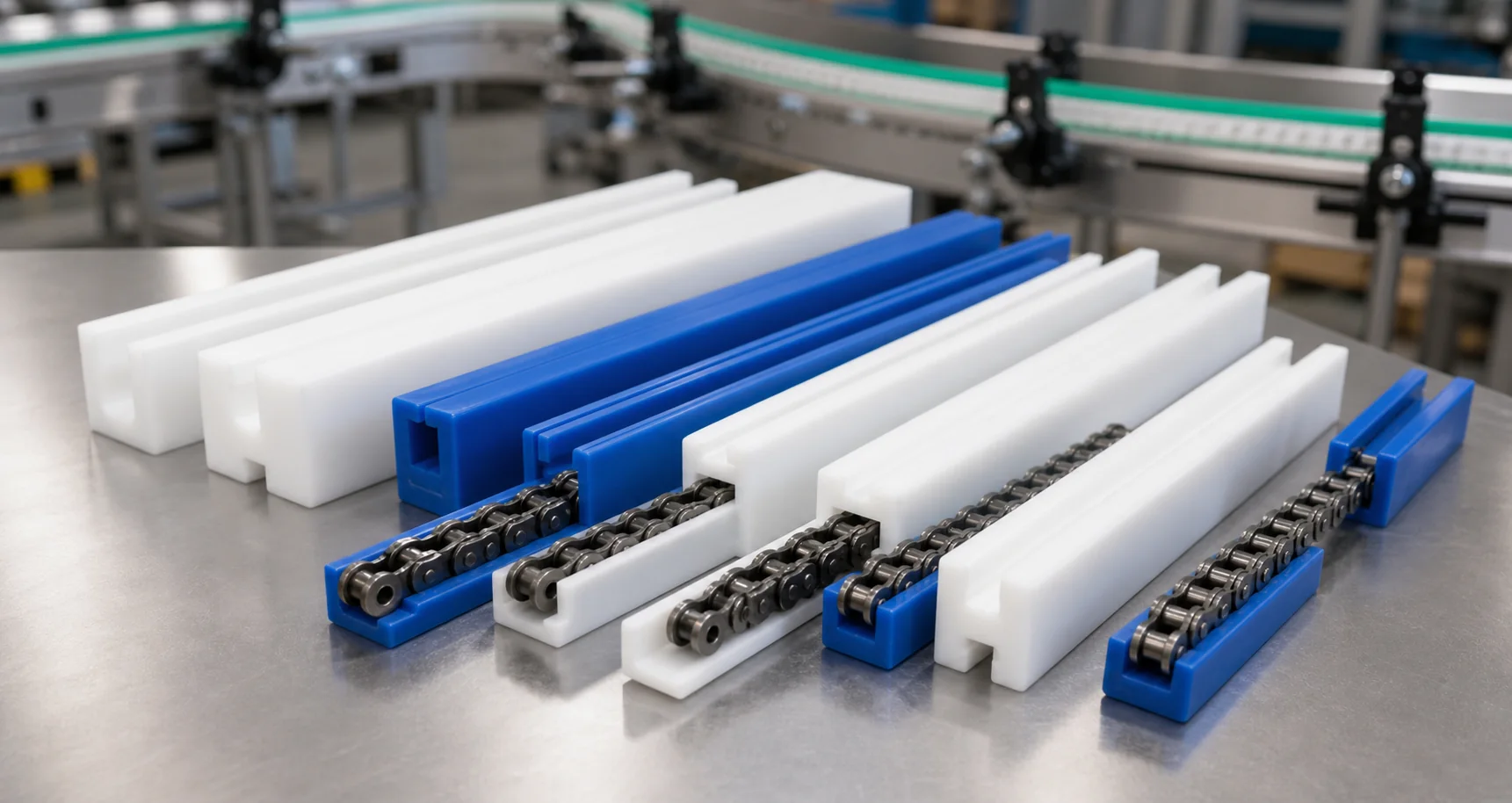
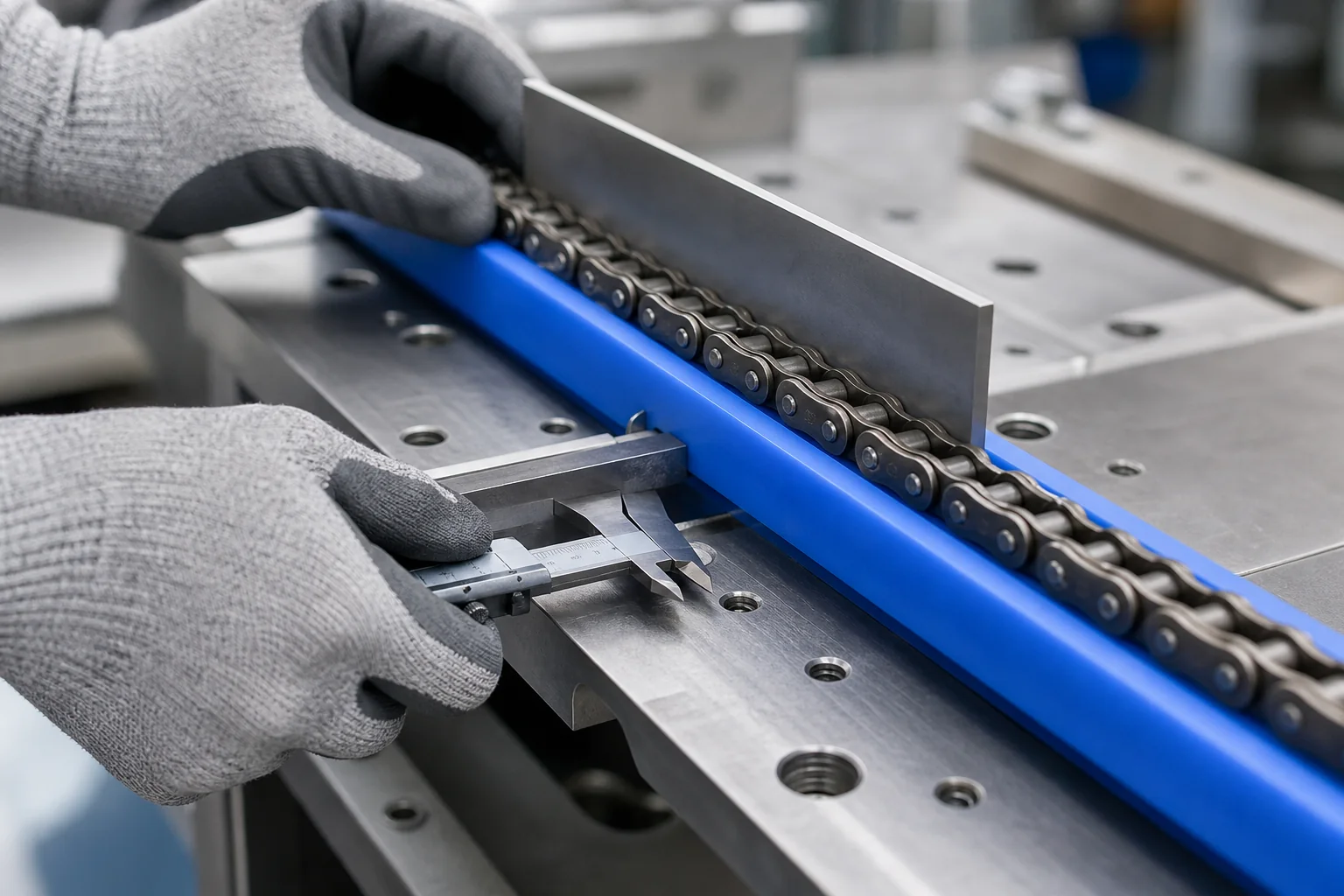
Chain-to-guide fit map
Control the Chain, Profile, Carrier and Expansion
- Chain: identify the manufacturer, number or dimensional standard.
- Profile: define contact points, side clearance, channel depth and lead-in.
- Carrier: measure the metal rail, support spacing and replacement direction.
- Expansion: define fixed point, slots, end clearance and service temperature.
Chain Guide, Wear Strip and Sprocket Have Different Jobs
A sprocket engages the chain to transmit torque. A chain guide supports or laterally controls the chain along its travel. A wear strip is often a simpler replaceable sliding surface and may form part of the guide system. Keeping these functions separate prevents a guide page from competing with a sprocket specification and helps the buyer send the correct geometry.
The chain should enter the guide without impact or side forcing. If a sprocket, shaft or frame is misaligned, replacing the guide alone will usually produce the same one-sided wear. Entry transitions and the common centerline should therefore be reviewed in the assembly.
Select the Guide Profile from the Contact Path
| Guide Profile | 대표적인 기능 | RFQ Details to Confirm |
|---|---|---|
| U-channel guide | Supports and laterally contains roller chain | Chain width, side clearance, channel depth and mounting base |
| T or inverted-T profile | Provides a guided wear surface with compact support | Profile retention, metal carrier, access and thermal movement |
| C or clip-on profile | Snaps or slides onto a metal rail | Carrier dimensions, retention force, end stop and replacement direction |
| Flat wear strip | Supports chain side plates or conveyor return path | Contact width, edge bevel, support spacing and debris escape |
| Curved or corner track | Guides chain through a turn | Working radius, chain type, tab or bevel geometry and entry alignment |
| Custom multi-lane guide | Controls several chains or product paths | Lane spacing, common datum, frame stiffness and installation sequence |
Profile names are not universal dimensions. Two U-channel guides can have different wall thickness, groove depth, base width and carrier method. For a replacement, include the chain and metal support dimensions, not only a photograph of the worn polymer.
Material and Grade Direction
| 소재 방향 | 공통된 출발점 | 구매자 유의사항 |
|---|---|---|
| Virgin UHMW-PE | General low-friction chain support and wear guidance | Allow for long-length thermal expansion, support and grade documentation |
| Reprocessed UHMW-PE | Selected cost-sensitive nonregulated applications | Property and color consistency may differ; obtain approval before substitution |
| Detectable or static-control grade | Qualified food-safety or electronics processes | Specify the exact detection or electrical requirement and supporting documents |
| 나일론 | Higher stiffness or load in selected guide and wear-block designs | Moisture, temperature and friction system require review |
| POM / 아세탈 | Precision guide features and lower moisture uptake | Confirm impact, chain contact, chemicals and long-section economics |
UHMW is a common starting material because it combines low friction with useful impact and wear behavior, but its thermal expansion and lower stiffness matter in long guides. Nylon or acetal can be considered when stiffness, load or dimensional stability changes the design balance. Food-contact, detectable, static-control or other regulated requirements must name the exact grade and required documentation; blue or white color alone is not evidence.
Design Long Guides for Movement and Maintenance
- Fixed reference: define where the guide is positively located along its length.
- Expansion allowance: use slots or end clearance appropriate to material, length and temperature range.
- Continuous support: prevent the profile from sagging, buckling or rotating under chain load.
- Fastener protection: keep screw heads below the wear path and accessible for replacement.
- Lead-in: guide the chain smoothly into the channel without a sharp impact edge.
- Cleaning and debris: provide drainage, relief or removal access when particles or washdown are present.
A long UHMW guide should not be clamped rigidly at every hole as if it were a steel rail. At the same time, excessive freedom can let the profile migrate into a sprocket or guard. The drawing needs a deliberate fixed-point and sliding-point strategy. Curved guides also require the actual chain path and radius, because bending a straight profile on site may distort the working groove.
Common Chain Guide Failures and Fixes
| Observed Failure | Probable Cause | 실용적인 해결책 |
|---|---|---|
| Chain climbs out of the guide | Profile, entry alignment or side clearance does not match the chain | Verify chain dimensions and create a controlled lead-in transition |
| Guide buckles between fasteners | Thermal expansion is trapped or support spacing is too large | Use suitable slots, end restraint strategy and continuous support |
| Mounting holes elongate | Fasteners carry thermal movement or impact load | Separate location from expansion and use suitable washers or carrier design |
| One wall wears rapidly | Sprockets, shafts or guide centerline are misaligned | Correct chain line before replacing the guide with a harder grade |
| Debris packs in the channel | Profile has no relief or cleaning path | Add practical clearance, drainage or access based on contamination |
| Replacement profile will not fit | Only nominal profile type was specified | Measure the metal carrier, chain and worn sample with a common datum |
CNC Machined, Extruded or Carrier-Mounted?
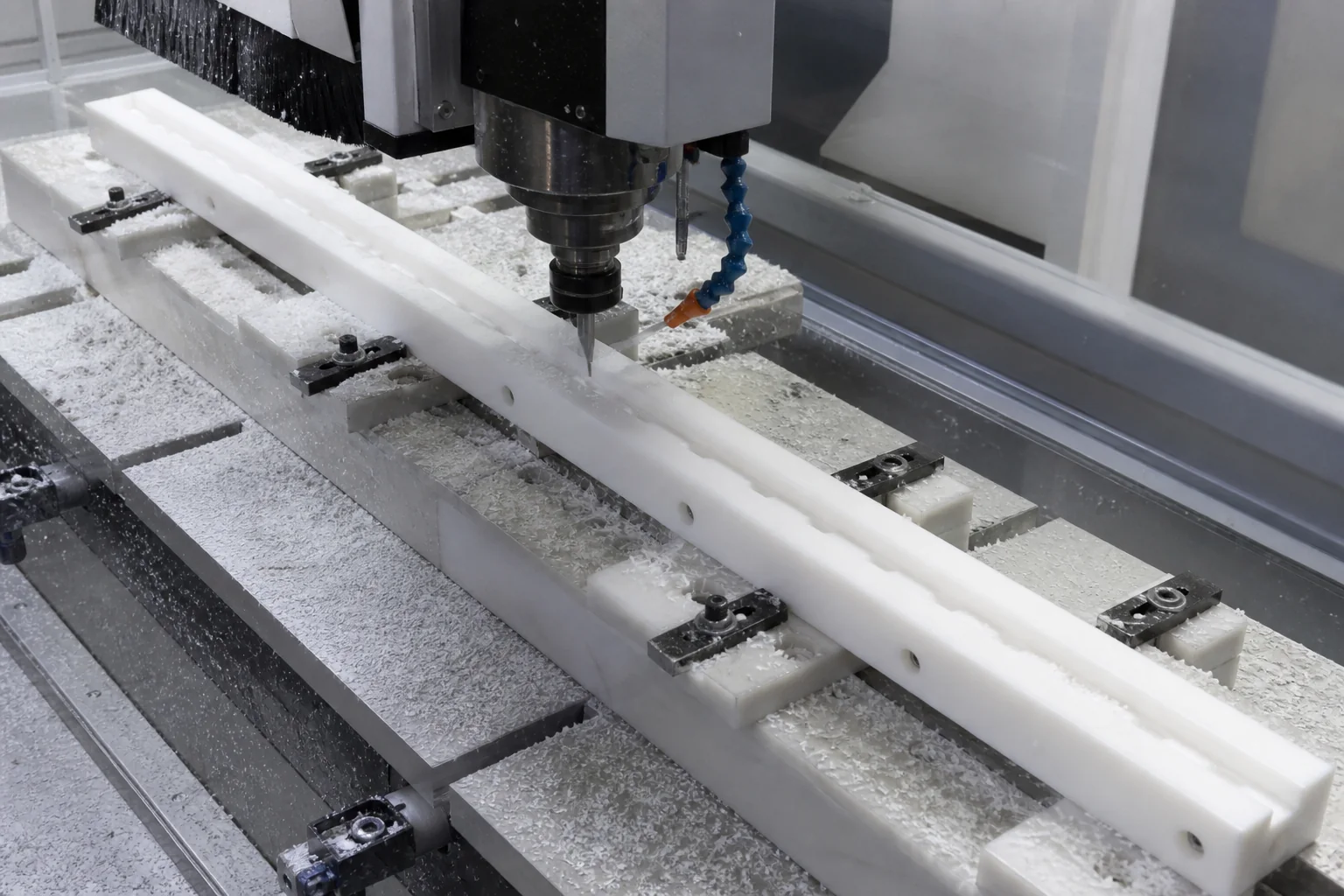
CNC machining is well suited to custom channels, mounting holes, slots, complex profiles, short runs and replacement guides from a sample. Long parts need supported workholding and an inspection plan that reflects flexible polymer behavior. Standard continuous profiles may be more economical when an extrusion already matches the chain and carrier.
A carrier-mounted design separates stiffness and attachment from the replaceable wear surface. It can simplify maintenance, but the metal section, clip geometry and end retention become part of the purchase specification. Curved tracks and multi-lane guides may use machined segments or near-net shapes depending on radius, volume and assembly access.
관련 엔지니어링 자료
- Plastic Sprocket Manufacturer and Chain Fit Guide
- UHMW CNC Machining Services
- Plastic Bearing Materials and Wear Grades
- 맞춤 가공 플라스틱 부품
자주 묻는 질문
What does a plastic chain guides manufacturer need for a quote?
Provide the chain manufacturer and number or dimensional standard, guide profile, length, carrier dimensions, mounting pattern, speed, load, environment, quantity and an assembly drawing or sample.
Why is UHMW commonly used for chain guides?
UHMW offers low friction, impact resistance and useful wear behavior for many conveyor duties. Long-length expansion, stiffness, support and the exact grade still require design review.
How much clearance should a chain guide have?
Clearance depends on chain dimensions, articulation, speed, contamination, alignment and thermal movement. It should be based on the specified chain and operating system rather than one universal number.
Can a worn chain guide be reverse engineered?
Yes, but the original profile may be hidden by wear. The chain, carrier and unworn datum features should be measured so the replacement does not reproduce distortion.
Are plastic chain guides machined or extruded?
Standard continuous profiles may be extruded, while custom channels, holes, slots, corners and low-volume replacements are commonly machined. Some assemblies combine an extruded wear profile with a metal carrier.
Request a Custom Chain Guide Review
For a new conveyor guide or a replacement profile, send the guide and carrier drawing and the matching chain designation. Nylon Plastic has supported engineering-plastic selection and custom manufacturing since 2005; the review connects chain fit, guide geometry, carrier support and material choice before quotation.
요청서에 포함해야 할 내용
- Chain identity: manufacturer, chain number or standard, pitch, roller diameter, overall width and attachments.
- Guide geometry: profile cross-section, length, straight or curved path, lane count and lead-in details.
- Carrier: metal rail section, mounting pattern, support spacing, frame datum and installation access.
- Operating case: chain speed, tension, load, starts, impact, lubrication and daily duty.
- 환경: temperature range, washdown, cleaners, chemicals, dust, abrasives and UV exposure.
- Quality scope: critical profile dimensions, straightness, hole position, conditioning and inspection report.
- 수량 및 시기: replacement urgency, prototype and annual quantities, standard length and packaging needs.
- 자료 및 승인: exact grade or permitted alternative, unworn datum and mounting features, installed clearances, and the agreed chain-fit or operating check. For a material-only request, identify the current grade and service conditions.
Ask the quote to distinguish the plastic profile from a carrier-mounted assembly. Confirm whether profile machining, holes and slots, carrier or fasteners, cut lengths, inspection, labeling and packaging are included. A worn sample helps identify the profile; use chain and carrier data to establish the replacement dimensions rather than reproducing the worn shape. Agree the fit check before releasing a repeat order.