Why Plastic Gears Are Replacing Metal in Modern Power Transmission
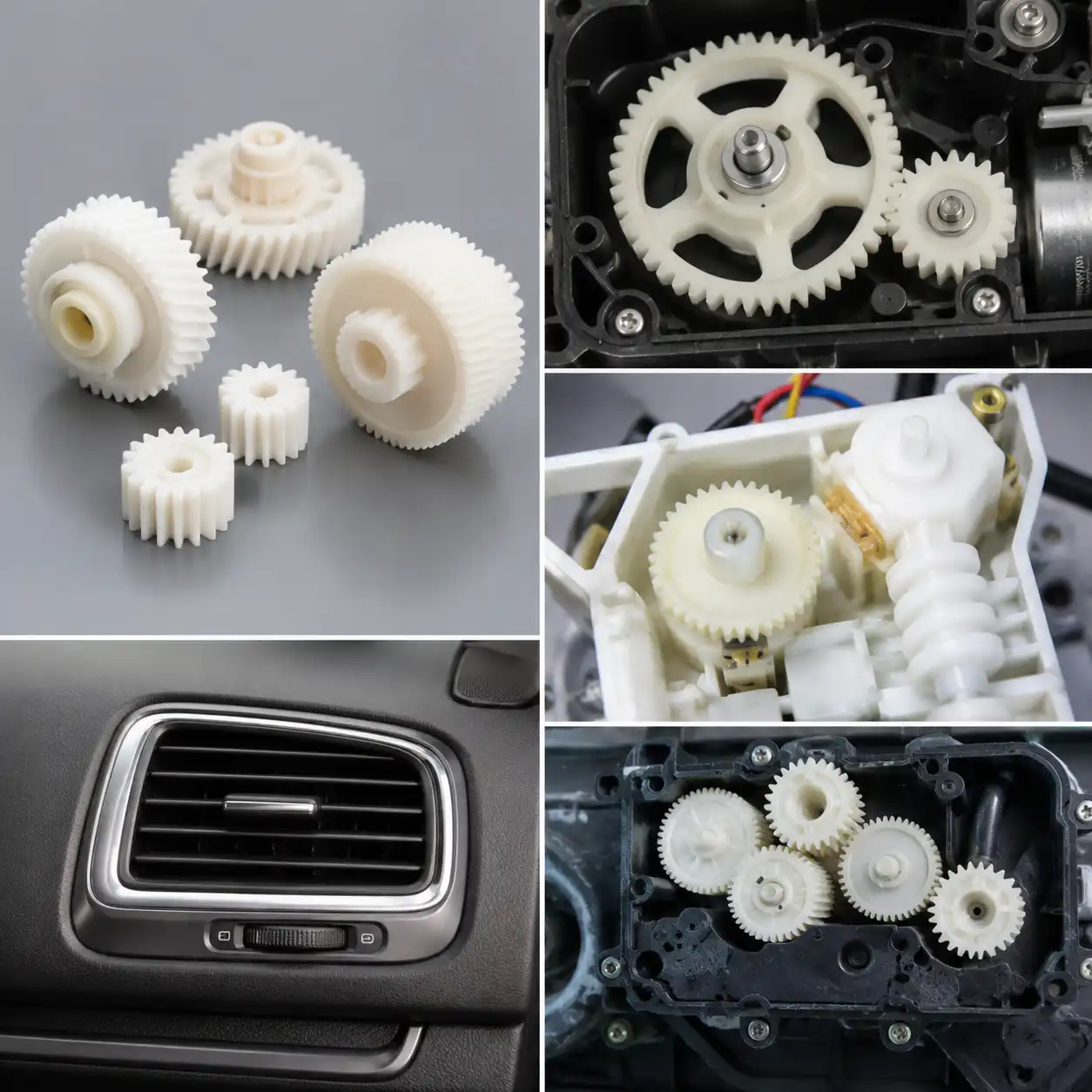
Plastic gears have moved well beyond light-duty consumer products. Today they transmit power in automotive steering systems, industrial robots, medical pumps, and aerospace actuators. The technology drivers are compelling: lower weight, elimination of lubrication in many applications, noise reduction of 6 to 10 dBA compared to metal gears, corrosion immunity, and the ability to mold complex geometries that would be cost-prohibitive to machine. A well-designed plastic gear can outperform a metal gear in medium-load intermittent-duty applications while costing 50% to 70% less at production volumes.
Success in plastic gear design, however, requires a fundamentally different engineering approach than metal gear design. Material selection, tooth geometry optimization, thermal management, and manufacturing process choice are all interconnected decisions that must be made together. This guide provides the complete framework for designing plastic gears that meet performance requirements while being producible at target cost.
Material Selection: The Foundation of Gear Performance
The material choice determines the gear’s operating limits for torque, speed, temperature, and lubrication regime. Selecting the wrong material for the load condition is the single most common cause of plastic gear failure.
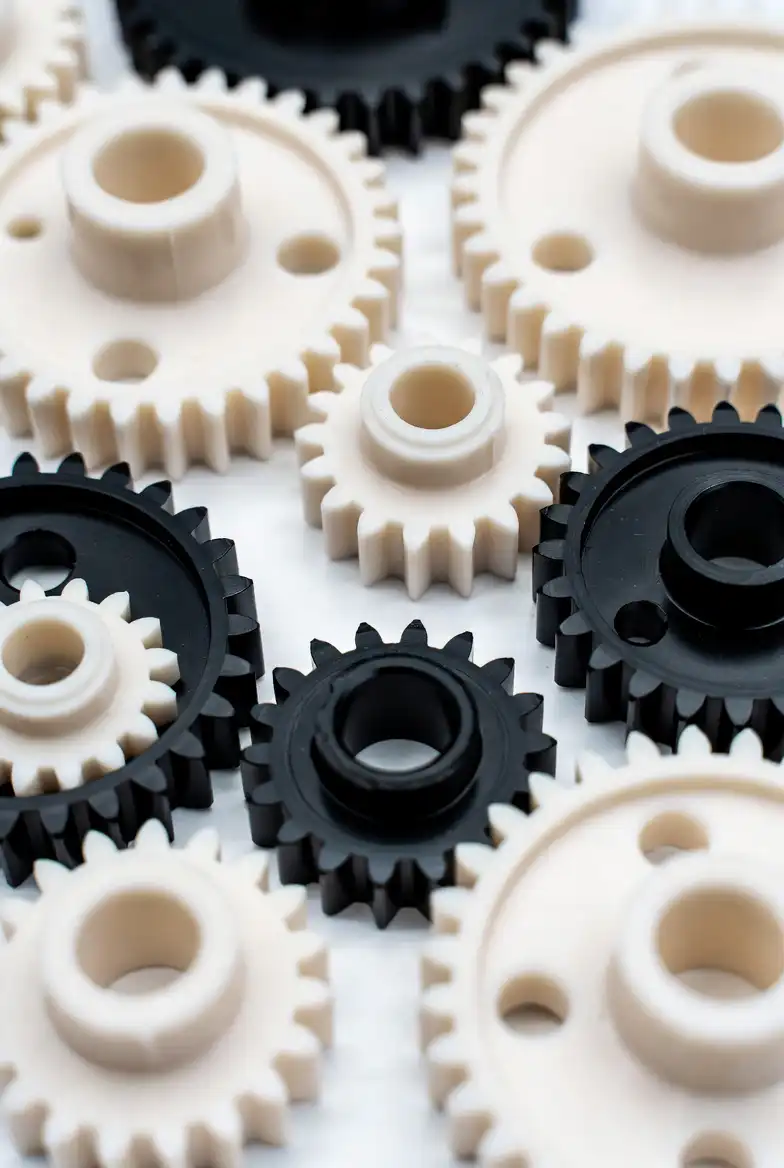
POM, acetal homopolymer and copolymer, is the most widely used plastic gear material. It offers an excellent balance of fatigue strength, low friction against both itself and metal, good dimensional stability, and reasonable cost at roughly $3 to $5 per kilogram. POM copolymer is preferred over homopolymer for gears because it offers better chemical resistance, lower centerline porosity that can cause fatigue crack initiation, and a wider processing window in injection molding. POM gears operate best in dry or grease-lubricated conditions at continuous temperatures up to 90 degrees Celsius, with intermittent capability to 120 degrees Celsius.
PA66 and PA6 offer higher temperature capability and better impact resistance than POM, making them suitable for gears that see shock loading or elevated temperatures. Glass-fiber-reinforced PA66 increases tooth bending strength by 50% to 80% compared to unfilled PA66, but the abrasive glass fibers accelerate wear against mating gears, requiring a lubricated system or a sacrificial wear partner. Nylon gears absorb moisture from the environment, typically 2% to 3% by weight at 50% relative humidity, which causes dimensional growth of 0.5% to 0.8% and a reduction in modulus of 25% to 40%. Gear tooth profiles must be designed for the conditioned dimensions and properties, not the dry-as-molded state.
For high-temperature applications, several materials extend the operating range. PA46 with a melting point of 295 degrees Celsius and continuous use temperature of 150 degrees Celsius unfilled and up to 180 degrees Celsius with glass fiber is specified for automotive under-hood gear applications including timing chain tensioners. PPS GF40 operates at continuous temperatures up to 220 degrees Celsius with excellent chemical resistance, making it suitable for chemical process equipment and oil pump gears. PEEK, with continuous use capability at 260 degrees Celsius, is specified for aerospace actuator gears, semiconductor equipment, and medical device gears that undergo repeated steam sterilization. PEEK carbon-fiber-reinforced grades provide tooth bending fatigue strength approaching die-cast zinc while weighing 80% less.
| Gear Material | Max Continuous Temp | Bending Fatigue at 10^7 Cycles (MPa) | Friction Coefficient (vs Steel) | 수분 효과 | 상대적 비용 | Best Application |
|---|---|---|---|---|---|---|
| POM Copolymer | 90 deg C | 30-35 | 0.15-0.25 | Minimal | 1x | General purpose, dry running, office equipment |
| PA66 (conditioned) | 120 deg C | 25-30 | 0.20-0.35 | Significant: dimensions and modulus | 1x | Shock loads, higher temperature, lubricated |
| PA66 GF30 | 130 deg C | 40-50 | 0.25-0.45 | Reduced vs unfilled | 1.3x | High tooth load, lubricated, metal mating gear |
| PA46 GF30 | 170 deg C | 45-55 | 0.25-0.45 | Reduced vs PA66 | 3x | Automotive under-hood, high temp lubricated |
| PPS GF40 | 220 deg C | 35-50 | 0.25-0.40 | 미미한 | 4x | Chemical environment, high temp, oil pump gears |
| PEEK CF30 | 260 deg C | 55-65 | 0.20-0.35 | 미미한 | 20x | Aerospace, medical, extreme environment |
Gear Tooth Geometry: The Involute Profile
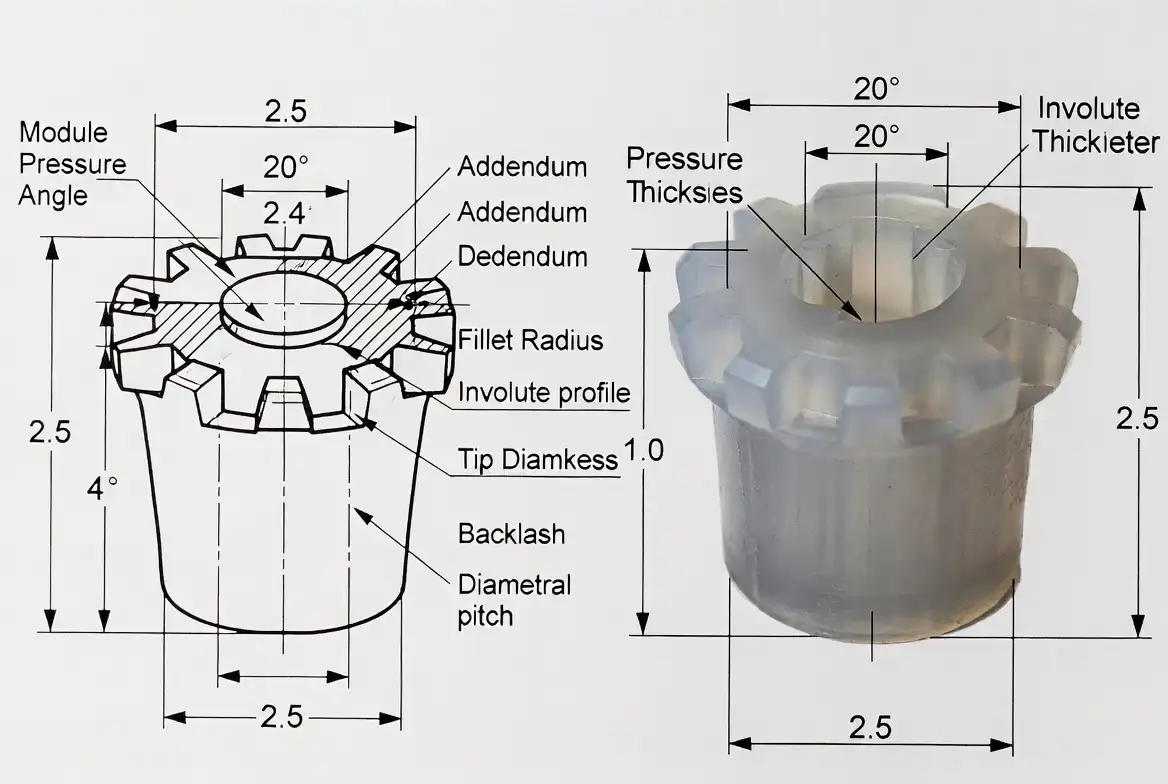
Plastic gears use the same involute tooth form as metal gears because the involute profile provides conjugate action, meaning the angular velocity ratio remains constant throughout mesh regardless of center distance variations. This is critical for plastic gears because thermal expansion and moisture absorption change the effective center distance in operation. The involute profile absorbs center distance variation without introducing transmission error, unlike cycloidal or other profiles.
Standard pressure angles for plastic gears are 20 degrees, matching the standard for metal gears and allowing interchangeability in mixed-material gear trains. A 14.5-degree pressure angle is occasionally used for light-duty applications because it produces quieter operation, but it results in weaker teeth with higher contact ratios and is generally not recommended for power transmission. For high-load plastic gears, a 25-degree pressure angle can increase tooth bending strength by 15% to 25% compared to a 20-degree tooth of the same module. The trade-off is higher radial bearing loads and slightly higher sliding velocity, which can affect wear rate in dry-running gears.
Tooth profile modification is essential for plastic gears. Tip relief, where a small amount of material is removed from the tip of the tooth, compensates for tooth deflection under load and reduces the impact noise as teeth enter mesh. For plastic gears, tip relief of 0.01 to 0.02 times the module is typical, which is approximately double the tip relief used on metal gears because plastic tooth deflection is greater. Root fillet radius is critical for plastic gear strength. A full-radius root fillet, as large as possible without causing interference with the mating gear tip, maximizes bending fatigue strength. Plastic gears should avoid the sharp root corners that metal gears can tolerate because plastics are notch-sensitive materials where fatigue cracks initiate at stress concentrations. A root fillet radius of at least 0.38 times the module is recommended, with 0.45 times the module preferred for high-load applications.
Tooth Strength Calculations for Plastic Gears
Plastic gear tooth strength is calculated using the Lewis bending equation adapted for plastic materials. The Lewis form factor accounts for the tooth geometry, while the material allowable stress accounts for the plastic’s temperature-dependent and rate-dependent properties. The critical difference from metal gear design is that the plastic allowable bending stress is not a single value. It depends on operating temperature, number of load cycles, and load duty cycle.
The allowable bending stress for a plastic gear at a given number of cycles is the material fatigue strength at that number of cycles divided by an appropriate safety factor. For POM at 10 million cycles at 23 degrees Celsius, the bending fatigue strength is approximately 30 to 35 MPa. For PA66 at the same conditions, it is approximately 25 to 30 MPa in the conditioned state, noting that dry-as-molded PA66 has higher strength that decreases with moisture absorption. For PEEK CF30 at 10 million cycles at 23 degrees Celsius, the bending fatigue strength is approximately 55 to 65 MPa, and this value is retained to significantly higher temperatures than POM or PA66.
Temperature derating is applied through a factor that reduces the allowable stress as operating temperature increases. For POM, the bending strength at 80 degrees Celsius is approximately 60% of the room temperature value. For PA66 at 120 degrees Celsius, it is approximately 50% of the room temperature conditioned value. PEEK retains over 80% of its room temperature bending strength at 150 degrees Celsius. The temperature derating curve for the specific material grade must be obtained from the material supplier and used in the gear design calculation.
Backlash and Clearance Design
Backlash is the clearance between mating gear teeth measured at the pitch circle. It is essential for plastic gears because it accommodates thermal expansion, moisture absorption, and manufacturing tolerances. Insufficient backlash causes tooth interference, increased friction and heat generation, and accelerated wear or seizure. Excessive backlash increases transmission error, noise, and impact loading as drive direction reverses.
For plastic gears, the recommended backlash is larger than for equivalent metal gears. A typical guideline is 0.04 to 0.08 times the module for plastic-to-plastic gear pairs, compared to 0.02 to 0.05 times the module for steel gears. The exact value depends on the material combination. Plastic-to-plastic pairs require more backlash because both gears expand. Plastic-to-metal pairs can use less backlash because only the plastic gear expands, and the metal gear acts as a heat sink. For high-temperature plastic gears operating near their maximum service temperature, the backlash should be calculated based on the differential thermal expansion between the gear material and the housing material, considering the full operating temperature range from cold start to maximum.
| Material Pair | Recommended Backlash (x Module) | Center Distance Tolerance | 운영 환경 |
|---|---|---|---|
| POM – POM | 0.06 – 0.10 | ISO Tolerance Grade 8-9, typically H8/h7 | Dry, ambient temperature stable |
| POM – Steel | 0.04 – 0.07 | ISO Tolerance Grade 7-8 | Dry or grease, moderate temperature range |
| PA66 – PA66 | 0.08 – 0.12 | ISO Tolerance Grade 8-9 | Accounts for moisture expansion; wider range |
| PA66 – Steel | 0.05 – 0.08 | ISO Tolerance Grade 7-8 | Higher temp; steel acts as heat sink |
| PEEK – PEEK | 0.05 – 0.08 | ISO Tolerance Grade 7-8 | High temp; low thermal expansion vs PA66 |
| PEEK – Steel | 0.04 – 0.06 | ISO Tolerance Grade 6-7 | Aerospace precision; minimal expansion |
Lubrication Strategies
Lubrication is a critical design decision that affects gear life by a factor of 2 to 5. The options range from dry running, which is unique to plastics and eliminates the cost and contamination of lubricants, to grease, oil bath, and solid lubricant systems.
Dry running is feasible for POM gears at low to moderate loads and speeds where the PV value, the product of contact pressure and sliding velocity, remains below the material’s limiting PV. For POM at low speed, the limiting PV is approximately 0.1 to 0.2 MPa times meters per second. Dry running requires careful material pairing. POM against POM provides the lowest friction and wear in dry conditions. POM against PA66 increases wear rate because the materials are chemically dissimilar and do not form the beneficial transfer film that POM-to-POM contact develops.
Grease lubrication extends gear life significantly and is the most common lubrication method for plastic gears in industrial applications. Synthetic hydrocarbon or perfluoropolyether greases are preferred because mineral oil-based greases can cause stress cracking in some engineering plastics, particularly polycarbonate and amorphous nylons, though POM and PA66 are generally compatible with mineral greases. The grease should be applied sparingly; excess grease increases churning losses and operating temperature without providing additional benefit. A film of approximately 10 to 50 micrometers between the gear teeth is sufficient for boundary and mixed-film lubrication regimes.
Internal lubrication by incorporating solid lubricants into the plastic compound eliminates the need for external lubrication in many applications. PTFE-filled POM provides a coefficient of friction reduction of 20% to 30% compared to unfilled POM. Silicone oil-filled grades migrate lubricant to the surface throughout the gear’s life. MoS2-filled PA66 provides dry lubrication for high-temperature applications where external grease would degrade. Solid lubricant fillers typically reduce the base resin’s tensile and flexural strength by 5% to 15%, which must be accounted for in the tooth strength calculation.
Manufacturing Methods: Injection Molding, CNC Machining, and Hobbing
Injection molding is the dominant manufacturing method for plastic gears at production volumes above 2,000 to 5,000 pieces per year. It produces finished gears in cycle times of 15 to 45 seconds with no secondary machining required. The mold must account for material shrinkage, typically 1.5% to 2.5% for unfilled materials and 0.3% to 1.0% for glass-fiber-reinforced grades, applied to each dimension. For precision gears, mold flow analysis and iterative tool adjustment are required because shrinkage is not perfectly isotropic, particularly in fiber-reinforced materials where shrinkage is lower in the flow direction than perpendicular to it. Gear molds require the highest precision of any injection mold category, with cavity dimensional tolerances of plus or minus 0.005 mm for precision gear teeth and runout tolerances of 0.01 mm or less between the gear bore and the tooth profile.
CNC machining from rod or plate stock is the preferred method for prototype gears, low-volume production up to 2,000 pieces, and materials like PEEK and PAI that are challenging to injection mold. Machined plastic gears achieve higher accuracy than molded gears, with AGMA quality class 8 to 10 achievable compared to class 7 to 9 for molded plastic gears. Machining avoids the melt-processing step that degrades some high-temperature polymers, preserving the material properties of the stock shape. The limitation of machined plastic gears is cost per piece, which is typically 3 to 10 times higher than molded gears at equivalent quality for production quantities above 5,000 pieces. Machining also limits gear geometry to what cutting tools can produce, whereas molding can produce complex geometries including internal gears, face gears, and crowned teeth without additional operations.
Gear hobbing is applicable to some engineering plastics and can produce external spur and helical gears with AGMA quality 8 to 10 at medium volumes. The hobbing process generates the involute profile through the relative motion of the hob cutter and the gear blank, producing a theoretically correct involute rather than the approximation produced by individual cutters in CNC machining. Hobbing is faster than CNC machining for simple spur and helical gears in the 10 to 100 mm diameter range, with cycle times of 30 to 120 seconds per gear. It is limited to external gears with simple hub geometries and cannot produce the complex integrated features that injection molding can combine in a single part.
Wear Testing and Validation
Plastic gear wear testing must replicate the actual operating conditions of load, speed, duty cycle, temperature, and lubrication state. A back-to-back gear test rig, where two identical gear sets are loaded against each other with a torque application mechanism, provides the most representative accelerated wear test for power transmission gears. The test should run for a minimum of 10 million cycles for a preliminary wear assessment and 50 to 100 million cycles for a full design validation for applications requiring long service life.
Wear is measured as the change in tooth thickness at the pitch circle over the test duration. A wear rate of less than 1% tooth thickness change per 10 million cycles is considered acceptable for most industrial applications. Higher precision applications such as robotics and aerospace may require wear rates below 0.2% per 10 million cycles. Post-test inspection includes tooth thickness measurement, surface roughness measurement of the active flank, and microscopic examination for pitting, spalling, or cracking. Weight loss measurement provides a rapid but less discriminating wear assessment that complements dimensional measurement.
Common Failure Modes and Prevention
Tooth bending fatigue is the most common failure mode in plastic power transmission gears and is characterized by cracks initiating at the root fillet and propagating across the tooth base. Prevention requires adequate root fillet radius, correct material selection for the operating temperature and number of cycles, and a safety factor of 1.5 to 2.0 on the calculated bending stress relative to the material fatigue strength.
Surface pitting occurs when cyclic contact stress exceeds the material’s surface fatigue limit, causing particles to detach from the tooth flank. Plastic gears are less susceptible to classical pitting than metal gears because plastic’s lower modulus distributes the contact load over a larger area, but pitting does occur in heavily loaded gears, particularly with glass-fiber-reinforced materials where the fiber ends act as stress concentrators at the surface. Prevention requires limiting the contact stress to below the material’s surface fatigue limit and ensuring adequate lubrication film thickness.
Thermal failure occurs when frictional heating from tooth sliding and hysteresis heating from cyclic material deformation raises the tooth temperature above the material’s thermal capability. The tooth tip, where sliding velocity and contact stress are highest, is typically the hottest location. Thermal failure manifests as surface melting, material softening leading to plastic deformation, and rapid wear. Prevention requires limiting the gear’s operating temperature through material selection, lubrication, reducing sliding velocity by using smaller modules or helical gears, and designing for adequate heat dissipation through the gear body, shaft, and housing.
자주 묻는 질문
플라스틱 기어가 전달할 수 있는 최대 출력은 얼마인가요?
There is no single answer because power capacity depends on gear size, material, operating speed, temperature, and duty cycle. As a rough guide, a 50 mm diameter POM spur gear can transmit approximately 0.5 to 1.0 kW at 1,500 RPM in continuous lubricated operation. The same gear in PEEK CF30 can transmit approximately 1.5 to 2.5 kW. For applications requiring higher power, increasing the gear diameter, face width, or using helical rather than spur gears all increase capacity. Consulting the material supplier’s gear design data and performing application-specific analysis is essential.
플라스틱 기어는 윤활유 없이도 작동할 수 있나요?
네, POM 기어는 건식 운전을 위해 특별히 설계되었으며, 윤활유 없이 사무기기, 경량 전동 공구 및 소비재에 널리 사용됩니다. 제한 요인은 PV 값입니다. 건식 운전용 POM 기어의 경우, 제한 PV 값은 일반적으로 연속 운전 시 0.1~0.15 MPa·m/s, 간헐 운전 시 최대 0.3 MPa·m/s입니다. 한계 PV를 초과하면 급격한 마모와 열적 고장이 발생합니다. POM 컴파운드에 PTFE 또는 실리콘 내부 윤활제를 첨가하면 건식 운전 PV 한계를 높일 수 있습니다.
기어 설계 시 나일론의 수분 흡수 특성을 어떻게 보완해야 할까요?
성형 직후의 치수가 아닌, 조건부 치수에 맞춰 기어 톱니 형상을 설계하십시오. 사용 환경의 예상 평형 수분 함량을 기준으로 금형 캐비티 치수를 지정하십시오. 일반적으로 상대 습도 50%에서 PA66의 수분 흡수율은 2.5%이며, 이로 인해 약 0.6%의 선형 팽창이 발생합니다. 계산에 사용되는 톱니 굽힘 피로 강도는 조건부 값이어야 하며, 이는 일반적으로 성형 직후 건조 상태의 값보다 25%에서 40% 정도 낮습니다. 하우징 내의 중심 거리는 완전히 조건이 적용된 기어 치수에 공차 여유를 더한 값을 수용할 수 있어야 합니다.
플라스틱 기어를 제작할 때, 사출 성형 대신 CNC 가공을 선택해야 하는 경우는 언제인가요?
CNC 가공은 최대 100개까지의 시제품 생산, 금형 투자 비용 회수가 경제적으로 타당하지 않은 연간 2,000개 미만의 생산량, 높은 금형 온도가 요구되어 사출 성형이 어려운 PEEK 및 PAI 기어, 사출 성형으로는 달성하기 어려운 AGMA 품질 등급 9 또는 10의 정밀도가 요구되는 기어, 그리고 금형 비용이 지나치게 높아지는 직경 200mm 이상의 대형 기어의 경우에도 적합합니다. 또한 가공 공정은 제품 개발 단계에서 설계 수정 시 더 빠른 처리 속도를 제공합니다.
기어에 사용되는 POM 단일중합체와 공중합체의 차이점은 무엇이며, 어떤 것을 선택해야 할까요?
기어에는 POM 공중합체가 가장 선호됩니다. 공중합체는 공단량체 단위가 고온에서 단일중합체에서 발생할 수 있는 ‘지퍼 열림’ 형태의 탈중합 현상을 차단하기 때문에, 더 우수한 장기 열적 안정성을 제공합니다. 또한 공중합체는 중심선 기공률이 낮아 톱니 중심부의 피로 균열 발생 지점을 줄여줍니다. 공중합체는 특히 알칼리 용액과 온수에 대해 더 우수한 내화학성을 제공합니다. 단일중합체는 결정도가 약간 더 높아 강도와 강성이 일반적으로 5%에서 10%까지 약간 더 높고 마찰계수도 약간 낮지만, 대부분의 기어 응용 분야에서 코폴리머가 갖는 신뢰성상의 이점이 이러한 사소한 장점들을 상쇄합니다.