Stringing (also called oozing or cobwebbing) occurs when molten filament leaks from the nozzle during non-printing travel moves, creating thin plastic threads between different parts of your print.
Primary Causes of Stringing
The most common cause is insufficient retraction, where filament continues flowing during travel. Temperature too high results in lower viscosity and easier flow. Material characteristics matter—PETG, TPU, and nylon are naturally prone to stringing. Wet filament creates steam bubbles forcing material out. Slow travel speed allows more time for oozing.
Optimal Retraction Settings
For PLA, use 4-6mm at 25-45mm/s. PETG works best at 3-5mm at 20-30mm/s. ABS needs 5-8mm at 35-50mm/s. Nylon requires 3-5mm at 25-35mm/s with thorough drying first. Our PA6-CF 필라멘트 is optimized for clean printing.
Slicer Settings That Help
Enable coasting to stop extrusion before travel. Use wipe to clean nozzle on printed surfaces. Activate combing to route travels through printed areas. Increase travel speed to 100-150mm/s for less time to ooze.
Source Quality Filaments
As a specialized source manufacturer, we supply filaments with tight diameter tolerance (±0.03mm) for consistent printing. 문의하기 for samples.
자주 묻는 질문
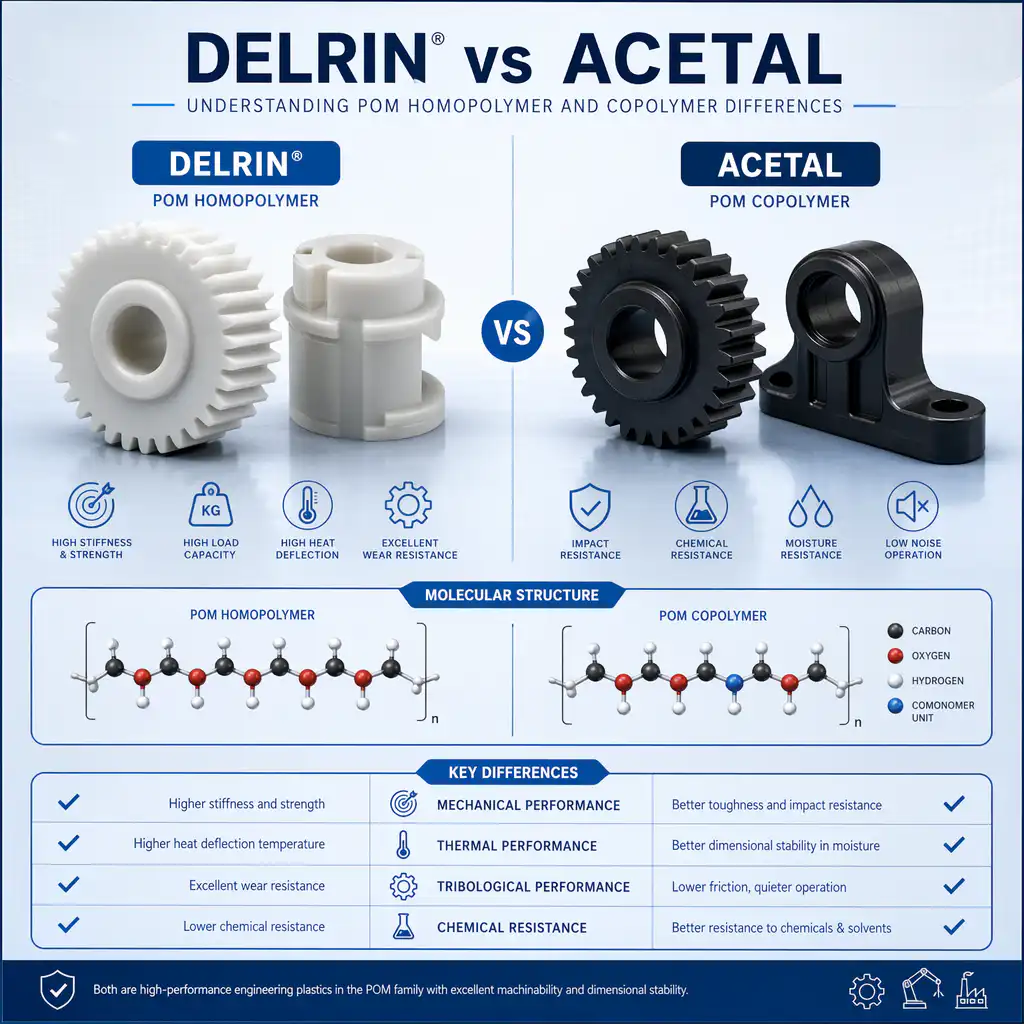
How do you know whether Delrin vs Acetal — Understanding POM Homopolymer and Copolymer Differences fits a part?
Delrin vs Acetal — Understanding POM Homopolymer and Copolymer Differences fits a part when its load capacity, temperature range, moisture exposure, wear behavior, and processing method match the real service conditions.
What properties should be checked for Delrin vs Acetal — Understanding POM Homopolymer and Copolymer Differences?
강도, 강성, 내충격성, 내열성, 수분 흡수율, 치수 안정성, 마찰, 마모 및 화학적 호환성을 확인하십시오.
What is the biggest selection risk for Delrin vs Acetal — Understanding POM Homopolymer and Copolymer Differences?
가장 큰 위험은 실제 환경, 가공 방법, 부품 형상 및 장기 사용 등을 고려하지 않고 데이터시트에 기재된 수치만 보고 선택하는 것입니다.
When should Delrin vs Acetal — Understanding POM Homopolymer and Copolymer Differences be tested before production?
부품이 하중, 열, 화학 물질, 습기, 엄격한 공차, 규제 요건 또는 새로운 작동 환경에 노출될 경우 시험을 실시하는 것이 좋습니다.