PEEK(폴리에테르에테르케톤)는 사출 성형이 가능한 열가소성 수지 중에서도 단연 최고 수준에 속합니다. 260°C의 연속 사용 온도, 불소수지와 견줄 만한 내화학성, 알루미늄에 필적하는 기계적 특성을 갖춘 PEEK는 다른 어떤 소재로도 해결할 수 없는 상황에서 가장 먼저 선택되는 소재입니다. 하지만 PEEK의 성형은 완전히 다른 차원의 문제입니다. 일반적인 사출 성형 장비와 공정 조건으로는 도저히 처리할 수 없습니다. 이 가이드에서는 PEEK 사출 성형 공정에 대해 알아야 할 모든 내용을 다룹니다.
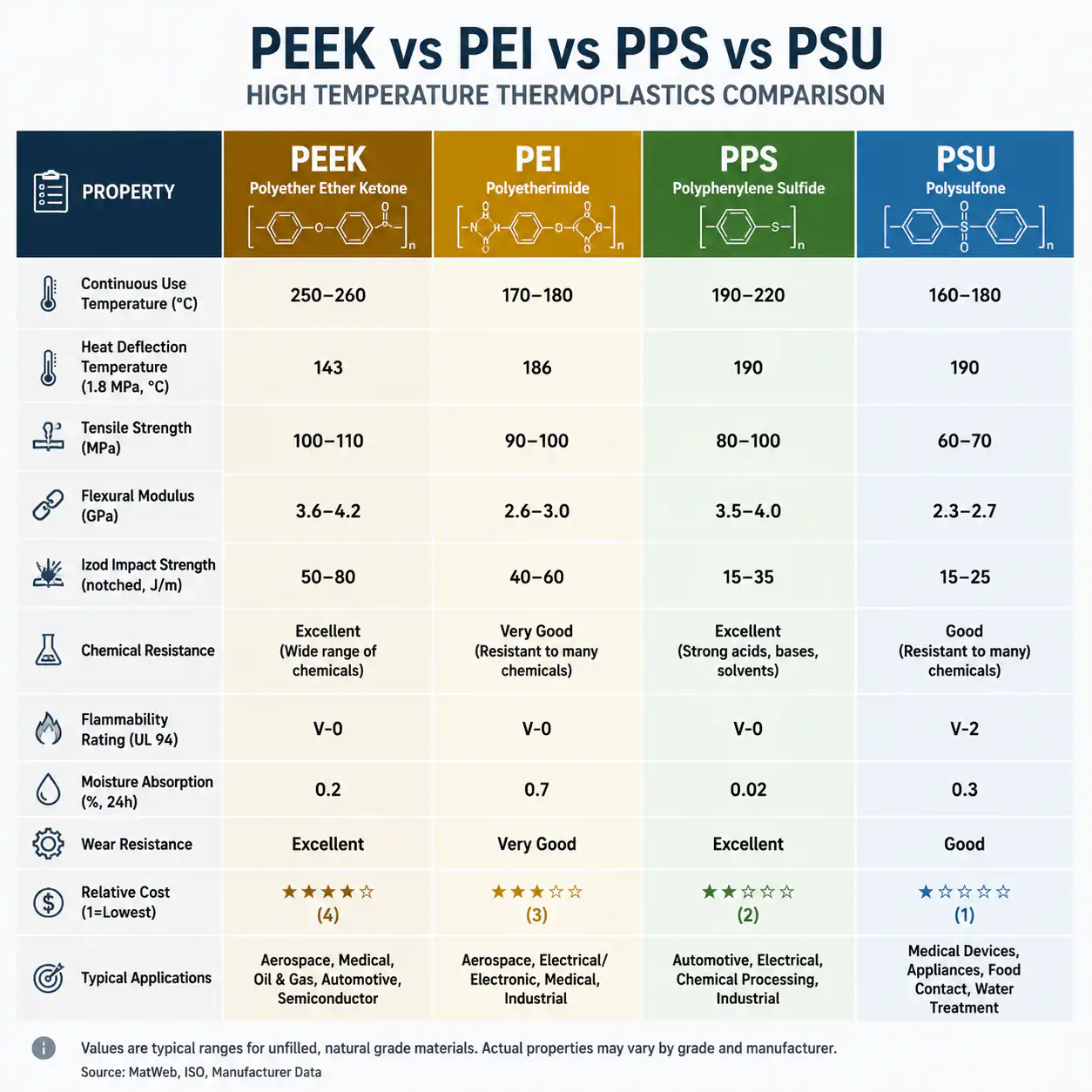
PEEK 소재 개요
PEEK는 반결정성 방향족 폴리에테르케톤으로, 유리전이온도(Tg) 143°C, 결정용융점(Tm) 343°C, 연속 사용 온도 260°C라는 독특한 특성 조합을 지니고 있습니다. 이 소재를 가공하려면 360–400°C의 온도가 필요하며, 이는 표준 사출 성형기의 처리 능력을 훨씬 초과하는 수준입니다.
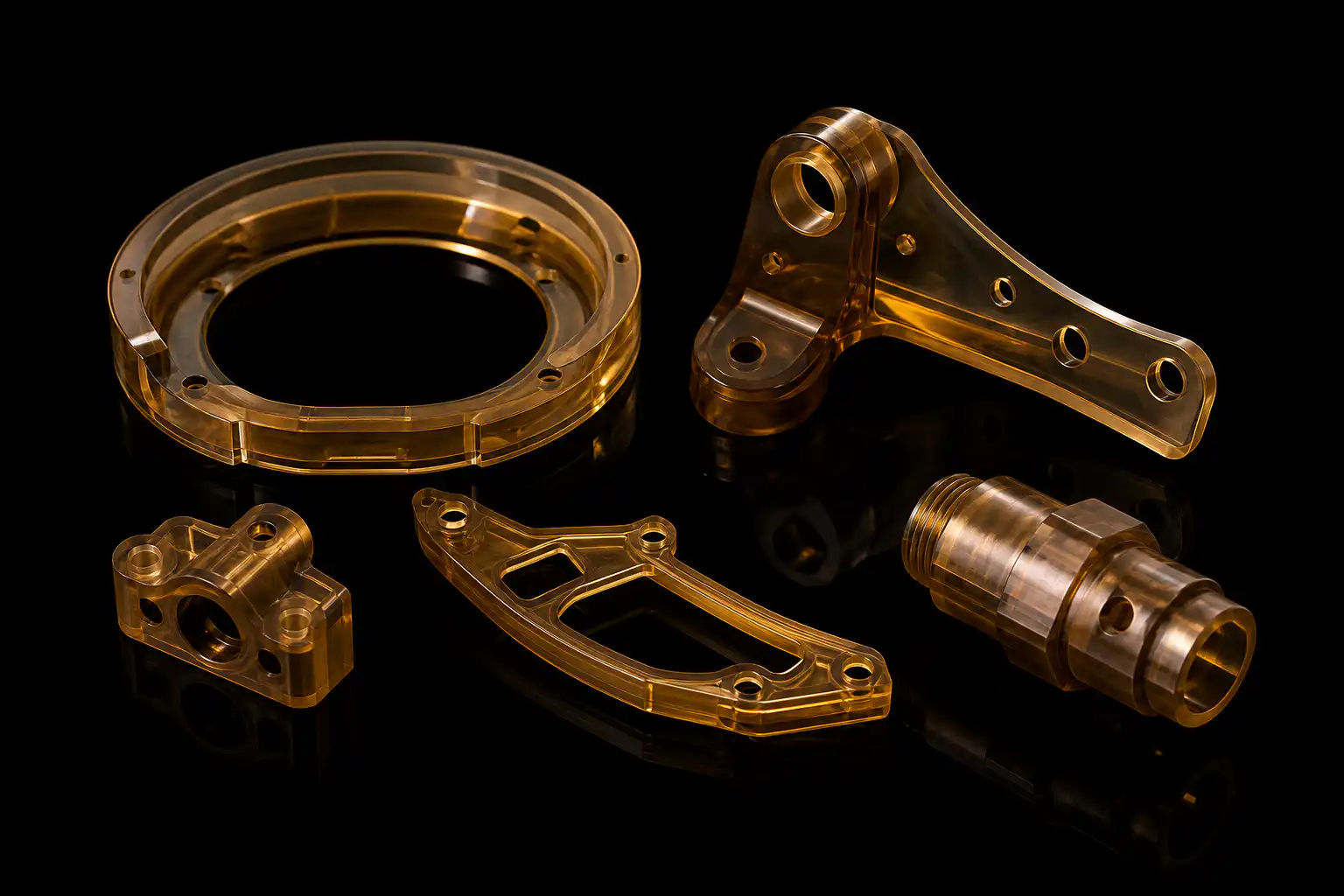
PEEK의 결정도는 이 소재 가공 시 가장 큰 난제입니다. PEEK는 냉각 속도에 따라 비정질 상태나 반결정질 상태로 존재할 수 있으며, 두 상태 간의 물성 차이는 극명합니다. 비정질 PEEK는 내화학성이 낮고, Tg 이상의 탄성 계수가 낮으며, 내마모성도 떨어집니다. 적절한 결정도를 얻기 위해서는 160–200°C 범위에서 금형 온도를 정밀하게 제어해야 합니다.
| 속성 | 비정질 PEEK | 반결정성 PEEK |
|---|---|---|
| 인장 강도(MPa) | 90 | 100 |
| 탄성계수 (GPa) | 3.6 | 4.0 |
| 내화학성 | 보통 | 우수 |
| 내마모성 | 공정 | 우수 |
| 외관 | 투명한 호박색 | 불투명한 베이지/탄색 |
중요한 공정 매개변수
PEEK 성형에는 모든 매개변수에 걸쳐 정밀한 제어가 필요합니다. 다음은 충전재가 포함되지 않은 PEEK(Victrex 450G 또는 이에 상응하는 제품)에 권장되는 성형 프로파일입니다:
| 매개변수 | 권장 값 | 참고 |
|---|---|---|
| 배럴 후방 구역 | 350°C | 공급 구간 — Tg 이상이어야 하지만 과도한 열분해는 일어나지 않아야 함 |
| 배럴 중간 구역 | 360–370°C | 압축 구역 — 용융 및 균질화 |
| 배럴 전면 구역 | 370–380°C | 계량 구역 — 최종 온도 안정화 |
| 노즐 온도 | 380–390°C | 콜드 슬러그를 방지하고 원활한 사출을 보장합니다 |
| 금형 온도 | 160–200°C | 결정도에 매우 중요 — 오일 가열을 권장합니다 |
| 주입 속도 | 중간에서 빠른 속도 | 얇은 벽에서 조기 결빙을 방지합니다 |
| 압력 유지 | 70–100 MPa | 수축을 상쇄하기에 충분하다 |
| 배압 | 낮음 (2–5 bar) | 과도한 배압은 성능 저하를 초래합니다 |
| 나사 회전 속도 | 50–100 rpm | 전단 가열을 최소화하기 위한 적정 수준 |
| 재료 건조 | 150°C에서 3~4시간 | 목표 수분 함량 <0.02% |

왜 곰팡이 온도가 가장 중요한가
금형 온도는 PEEK에 있어 가장 중요한 단일 매개변수입니다. 금형 표면 온도는 냉각 속도를 직접적으로 제어하며, 이 냉각 속도가 결정화도를 결정합니다. 금형 온도가 150°C 미만이면 PEEK가 너무 빠르게 냉각되어 완전히 결정화되지 못하며, 그 결과 내화학성이 낮은 비결정질 표면층이 형성됩니다. 160–200°C에서는 냉각 속도가 스페룰라이트가 성장하기에 충분한 시간을 제공하여, 최적의 특성을 지닌 반결정질 PEEK가 생성됩니다.
금형 온도를 일정하게 유지해야 합니다 전체 공동 표면에 걸쳐 균일하게. ±5°C 이상의 온도 변동이 발생하면 결정도 차이가 있는 영역이 형성되며, 이는 뒤틀림, 일관성 없는 물성, 눈에 띄는 색상 변화(비결정질 영역은 투명한 호박색을 띠는 반면, 결정질 영역은 불투명한 황갈색을 띤다)로 나타납니다.
장비 요건
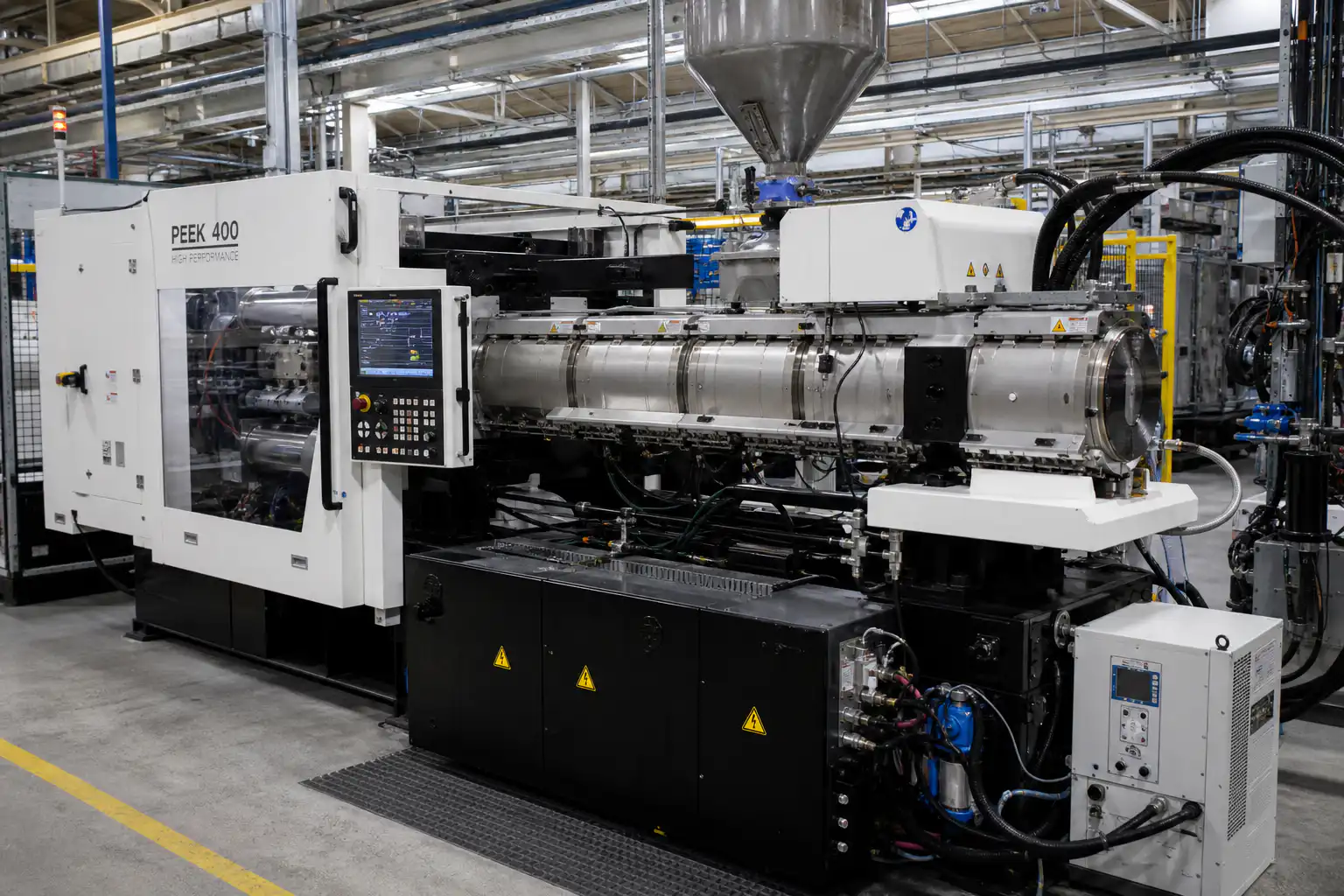
일반 사출 성형기는 PEEK 가공에 적합하지 않습니다. 최소 요구 사항은 다음과 같습니다:
- 배럴과 스크류: 최소 450°C에서 연속 운전이 가능한 세라믹 밴드 히터가 장착된 고온 배럴. 가공 온도에서 PEEK의 마모에 견딜 수 있도록 날 끝 부분이 경화 처리된(Colmonoy 56 또는 이에 상응하는 재질) 바이메탈 스크류.
- 압축비: 2.0:1 ~ 2.5:1의 나사 압축비. 압축비가 높을수록 과도한 전단 열이 발생하여 열화 현상을 일으킬 수 있습니다.
- 금형 가열: 최소 200°C까지 가열이 가능한 오일 순환식 금형 온도 조절기가 필요합니다. 전기 카트리지 히터도 대안으로 사용할 수 있지만, 균일한 온도 분포를 얻기 위해서는 세심한 다중 구역 제어가 필요합니다. 표준 수냉식 금형 온도 조절기는 최대 95–120°C까지만 가열 가능하므로 사용할 수 없습니다.
- Insulation Plates: Thermal insulation plates (typically 10–15mm thick phenolic or ceramic composite) between the mold and machine platens are essential. Without insulation, heat from the 180°C mold conducts into the machine platens, causing thermal expansion of the tie bars and inconsistent clamp force.
- 건조 중입니다: Desiccant dryer capable of 150°C with dew point below -40°C. PEEK moisture target is <0.02% — hydrolytic degradation at processing temperature is extremely rapid if moisture is present.

Mold Design for PEEK
Gate Types: Direct sprue gates and edge gates work well. Submarine gates and tunnel gates are problematic because PEEK’s high viscosity at normal processing temperature makes it difficult to shear through small gates. Hot runner systems must be rated for 400°C and use externally heated manifolds — internally heated hot runners create cold spots.
Venting: Vent depth must not exceed 0.01–0.02mm (PEEK has low melt viscosity at processing temperature and will flash through larger vents). Vent land length should be 0.5–1.0mm before the vent channel opens to full depth.
Runner Sizing: Full-round runners of 6–8mm diameter are recommended. PEEK solidifies quickly, and undersized runners freeze off before packing is complete.
Draft Angles: Minimum 1° draft, preferably 2° or more. PEEK adheres strongly to mold steel at elevated temperatures, and brittle at room temperature — insufficient draft leads to ejection cracking.
Mold Steel: H13 (SKD61) hardened to 52–56 HRC. P20 is acceptable for prototype molds but will wear more quickly. Stainless steel (S136/420SS) is recommended for medical applications due to corrosion resistance during steam sterilization of the mold between runs.
Common Defects and Fixes
| 결함 | 외관 | 근본 원인 | 수정 |
|---|---|---|---|
| Black Specks | Dark spots in translucent parts | Thermal degradation in barrel | Reduce barrel temperature, residence time, or screw speed. Purge thoroughly. |
| 뒤틀림 | Part distortion after ejection | Uneven crystallinity from mold temperature variation | Improve mold temperature uniformity. Increase mold temp to 180–200°C. |
| 싱크 자국 | Depressions at thick sections | Insufficient holding pressure or premature gate freeze | Increase holding pressure and time. Enlarge gate. |
| Burn Marks | Brown/black discoloration at flow end | Trapped air compression (diesel effect) | Improve venting. Reduce injection speed. |
| Incomplete Fill | Short shot, missing features | Premature solidification in thin walls | Increase injection speed and mold temperature. Add flow leaders. |

PEEK vs Other High-Temperature Thermoplastics
| 매개변수 | PEEK | PEI(울템) | PPS | PSU |
|---|---|---|---|---|
| Tg (°C) | 143 | 217 | 88 | 187 |
| Tm (°C) | 343 | 비정질 | 280 | 비정질 |
| Processing Temp (°C) | 360–400 | 350–400 | 300–340 | 330–380 |
| 금형 온도 (°C) | 160–200 | 135–165 | 135–150 | 120–160 |
| 연속 서비스 온도(°C) | 260 | 170 | 220 | 160 |
| 내화학성 | 우수 | Moderate — stress cracks in solvents | 우수 | Moderate — attacks by ketones |
| Material Cost ($/kg) | 80–120 | 25–40 | 15–25 | 20–30 |
Applications for PEEK Injection Molded Parts
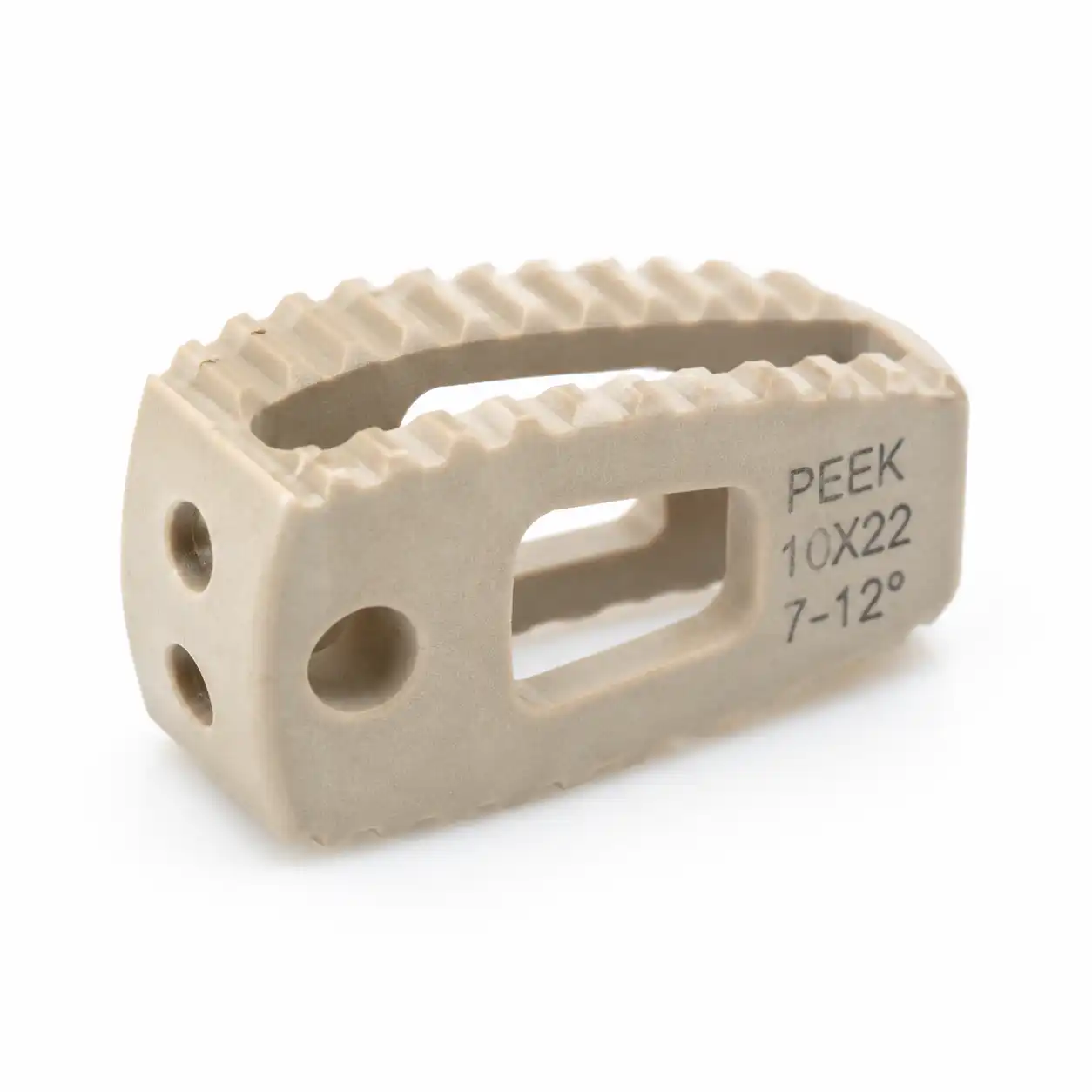
- 의료: Spinal fusion cages, dental implants, surgical instrument handles. PEEK’s radiolucency (invisible on X-ray) and biocompatibility (ISO 10993 certified grades available) make it the dominant material for implantable devices.
- 항공우주: Brackets, bushings, seals, and wire management components. PEEK replaces aluminum in weight-critical applications, saving 70% weight with comparable mechanical performance below 260°C.
- Semiconductor: Wafer handling components, CMP rings, etch chamber fixtures. PEEK’s combination of high purity, chemical resistance, and ESD-safe grades makes it essential for semiconductor manufacturing environments.
- Oil and Gas: Seals, backup rings, valve seats. PEEK’s resistance to H₂S, CO₂, and high-pressure steam at temperatures up to 200°C is unmatched by other thermoplastics.
Cost Breakdown
PEEK parts cost 5–10 times more than equivalent PA66 parts due to three compounding factors:
- 재료비: PEEK resin at $80–120/kg vs PA66 at $3–5/kg — a 20–40× material cost multiplier.
- Mold investment: Hot-oil heated molds with H13 hardened steel cost 2–3× more than standard P20 water-cooled molds.
- Cycle time: PEEK cooling in a 180°C mold takes significantly longer than nylon cooling in a 60°C mold. Cycle times of 60–120 seconds are typical for PEEK parts weighing 20–50g, compared to 15–30 seconds for equivalent nylon parts.

결론
PEEK injection molding is a specialized discipline that requires investment in high-temperature equipment and deep processing expertise. It is not a material you can run on a standard molding machine with a few parameter tweaks. But for applications that demand the highest combination of temperature resistance, chemical resistance, and mechanical properties available in a thermoplastic, PEEK is simply unmatched. The key to success is treating mold temperature control as your primary quality parameter, investing in proper drying, and working with a molder who has verified PEEK processing capability — not just a claim on a website.
자주 묻는 질문
PEEK는 일반 사출 성형기로 성형할 수 있습니까?
아닙니다. 표준 사출 성형기의 배럴 온도 한계는 일반적으로 300–350°C이며, 최대 95°C까지 냉각 가능한 수냉식 금형을 사용합니다. PEEK 사출 성형에는 360–400°C의 배럴 온도와 160–200°C의 금형 온도가 필요합니다. 최소한 이 기계에는 450°C 등급의 세라믹 밴드 히터, 바이메탈 스크류, 그리고 오일 순환식 금형 온도 제어기가 필요합니다. 표준 기계를 개조하는 것도 가능하지만, 종종 기계 본체 가격보다 더 많은 비용이 듭니다.
PEEK의 최소 금형 온도는 얼마입니까?
충진제가 첨가되지 않은 PEEK의 실질적인 최저 온도는 160°C입니다. 이 온도 이하에서는 냉각 속도가 너무 빨라 완전한 결정화가 이루어지지 않으며, 그 결과 Tg 이상에서 내화학성이 떨어지고 기계적 특성이 저하되는 비결정질 구조가 형성됩니다. 벽 두께가 얇은(1mm 미만) 부품의 경우, 조기 응고를 방지하기 위해 최소 온도가 180°C로 상승합니다. 탄소섬유 강화 PEEK의 경우 180–200°C를 권장합니다.
성형 과정에서 PEEK의 열화 현상을 방지하려면 어떻게 해야 하나요?
변질 방지는 다음 네 가지 요인에 달려 있습니다. (1) 수분을 0.02% 미만으로 건조시킵니다(150°C, 흡습제 건조기에서 3~4시간). (2) 체류 시간을 최소화합니다 — 380°C에서 5분 미만으로 유지합니다. (3) 전단 가열을 줄이기 위해 낮은 배압(2–5 bar)을 사용합니다. (4) PEEK 사출 사이에는 고온 퍼징 컴파운드나 열적으로 안정된 폴리머(예: PPS)를 사용하여 배럴을 퍼징하십시오. 검은 반점은 열화의 첫 번째 가시적 징후입니다. 이러한 현상이 보이면 즉시 온도와 체류 시간을 줄이십시오.
PEEK 사출 성형은 PEEK CNC 가공보다 비용이 더 많이 드나요?
연간 500~1,000개 이상의 생산량인 경우, 일반적으로 PEEK 재고 형재를 이용한 CNC 가공보다 사출 성형이 비용 효율적입니다. 사출 성형 금형 투자 비용(PEEK용 금형의 경우 $20,000–$80,000)은 생산량에 따라 상각되는 반면, CNC 가공 비용은 선형적으로 유지됩니다. 그러나 시제품 제작이나 500개 미만의 생산량인 경우, PEEK 봉이나 판재를 이용한 CNC 가공이 거의 항상 더 저렴합니다. 많은 프로그램이 CNC 시제품으로 시작하여, 양산 단계에서는 사출 성형으로 전환됩니다.