
PLA+ vs PLA is a useful comparison when printability, stiffness, and heat resistance need to be balanced for the final part.
PLA+ 이는 여러 대안을 비교하고, 한계를 확인하며, 위험이 적은 공정을 선택해야 할 때 유용한 공학적 주제입니다.

When engineers compare pla+ vs pla for real-world applications, they need more than anecdotal experience. They need quantified data on strength, thermal behavior, and print quality. This article provides a detailed, data-driven comparison of the mechanical and thermal properties that matter most for functional 3D printed parts.
PLA+ vs PLA: Tensile Strength Comparison
Tensile strength measures how much pulling force a material can withstand before breaking. In the pla+ vs pla comparison, this is where the most consistent difference appears:
| Test Specimen | Standard PLA | PLA+ (Brand A) | PLA+ (Brand B) |
|---|---|---|---|
| Tensile at Yield | 48-52 MPa | 52-58 MPa | 55-62 MPa |
| Tensile at Break | 42-48 MPa | 48-55 MPa | 50-58 MPa |
| Young’s Modulus | 3.0-3.5 GPa | 2.8-3.3 GPa | 2.9-3.4 GPa |
| 휴식 시 연신율 | 3-5% | 7-15% | 10-18% |
Heat Resistance: The Overlooked Differentiator
Heat resistance is measured by the Heat Deflection Temperature (HDT), which indicates the temperature at which a material begins to soften under load. When comparing pla+ vs pla in thermal performance, the differences are modest but can be significant in specific applications.
Standard PLA begins softening noticeably around 50-55°C. PLA+ typically adds 3-5°C to this threshold, reaching 55-60°C. While this seems minor, it can mean the difference between a part surviving in a hot car in summer (interior temperatures can reach 55-65°C in direct sunlight) or deforming within minutes. For parts intended for indoor use or temperature-controlled environments, this difference is irrelevant. For automotive interiors, kitchen appliances, or outdoor installations, it becomes critical.
Impact Resistance and Toughness
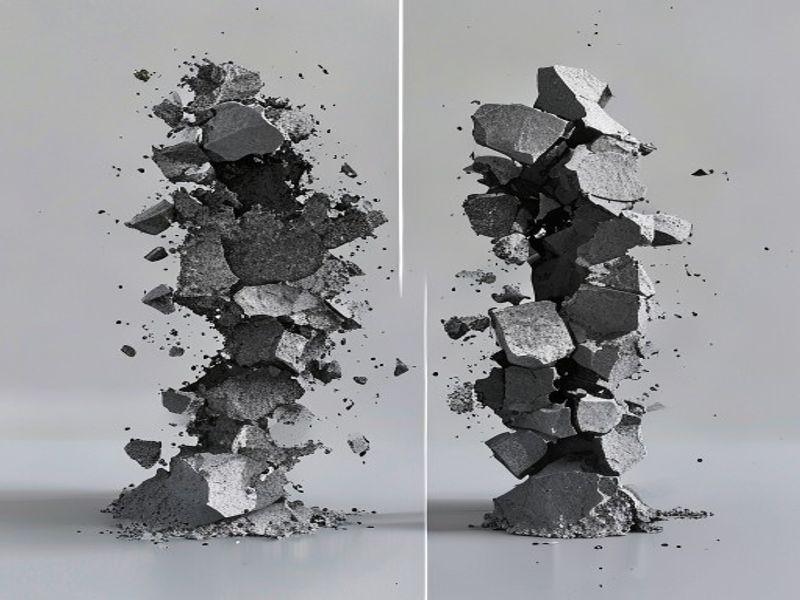
Impact resistance is the property that most dramatically separates pla+ vs pla. Standard PLA absorbs approximately 4-6 kJ/m² of impact energy before fracturing—roughly comparable to polystyrene. PLA+ absorbs 8-14 kJ/m², placing it closer to ABS in impact performance.
This 100-150% improvement transforms the practical utility of PLA-based parts. A gear printed in standard PLA will shatter if dropped onto a concrete floor from waist height. The same gear printed in PLA+ will typically survive multiple identical drops. For products shipped to customers, this shock-absorption capability significantly reduces damage during transit.
Layer Adhesion and Interlaminar Strength
Interlayer bonding strength is the Achilles heel of FDM printing, but it is an area where PLA+ excels. Standard PLA achieves 50-60% of its bulk strength across layer boundaries, creating natural fracture planes. PLA+ typically achieves 65-80% interlayer strength—a significant improvement that makes printed parts behave more like homogenous, injection-molded components.
Print Quality: PLA+ vs PLA Surface Finish
At optimized temperatures, PLA+ tends to produce a slightly glossier surface finish than standard PLA. The plasticizers and modifiers in PLA+ promote smoother melt flow, which fills minor gaps between extrusion lines more effectively. However, printing PLA+ at the wrong temperature (too low) magnifies surface defects because the modifiers interfere with proper melt behavior. Always perform temperature tower calibration when switching between PLA and PLA+ brands.
3D 프린팅 및 엔지니어링 플라스틱 용도로 나일론 플라스틱을 선택해야 하는 이유
엔지니어링 플라스틱 분야에서 10년 이상의 경험을 쌓아온 Nylon Plastic은 전 세계 B2B 고객사들에게 고성능 소재를 공급하고 있습니다. 당사의 제품 라인업에는 나일론(PA6, PA66, PA12), POM, PEEK 및 PLA, PLA+, PETG를 포함한 3D 프린팅 필라멘트가 포함됩니다. 모든 제품은 출하 전 직경 공차(±0.03mm), 수분 함량 및 기계적 특성에 대한 검사를 거칩니다.
- ISO 9001 인증을 받은 제조 시설
- 경쟁력 있는 B2B 가격으로 대량 공급
- 재료 선정 및 인쇄 매개변수에 대한 기술 지원
- 여러 물류 센터에서 제공하는 빠른 전 세계 배송
- OEM 프로젝트를 위한 맞춤형 소재 배합 가능
PLA+ vs PLA: Which One Fits the Part?
| 요구 사항 | PLA | PLA+ |
|---|---|---|
| Print setup | Low barrier to entry and stable first-layer behavior | Usually similar settings, but the formulation varies by brand |
| 강인함 | Good stiffness with lower impact tolerance | Often improved toughness, but verify the supplier’s test data |
| Heat exposure | Best for low-temperature service | May improve practical durability, but it is not automatically a high-temperature resin |
| Buyer check | Confirm color, diameter and print profile | Confirm the additive package, conditioning and measured properties |
Choose by the completed part, not the “plus” label alone. Check the actual load, heat, impact and surface requirements, then test the printed orientation and post-processing condition you will use in production. For a broader four-material comparison, see the 3D printing materials guide.
자주 묻는 질문
When is PLA+ vs PLA: Strength, Heat Resistance and Print Quality Compared a good option?
PLA+ vs PLA: Strength, Heat Resistance and Print Quality Compared is a good option when fast iteration, complex geometry, low tooling cost, or low-volume production is more important than molded-part unit cost.
What should be checked before choosing PLA+ vs PLA: Strength, Heat Resistance and Print Quality Compared?
부품 크기, 재료 특성, 표면 마감, 치수 공차, 열 노출, 하중 방향, 후처리가 필요한지 여부를 확인합니다.
How does PLA+ vs PLA: Strength, Heat Resistance and Print Quality Compared compare with CNC machining?
3D 프린팅은 복잡한 형상을 빠르게 제작할 수 있는 반면, CNC 가공은 정밀한 표면, 엄격한 공차 및 생산 등급 재료에 더 적합한 경우가 많습니다.
What affects the cost of PLA+ vs PLA: Strength, Heat Resistance and Print Quality Compared?
비용은 재료, 빌드 볼륨, 프린트 시간, 레이어 높이, 서포트 제거, 마감, 검사 및 빌드 내 부품 수에 따라 달라집니다.

