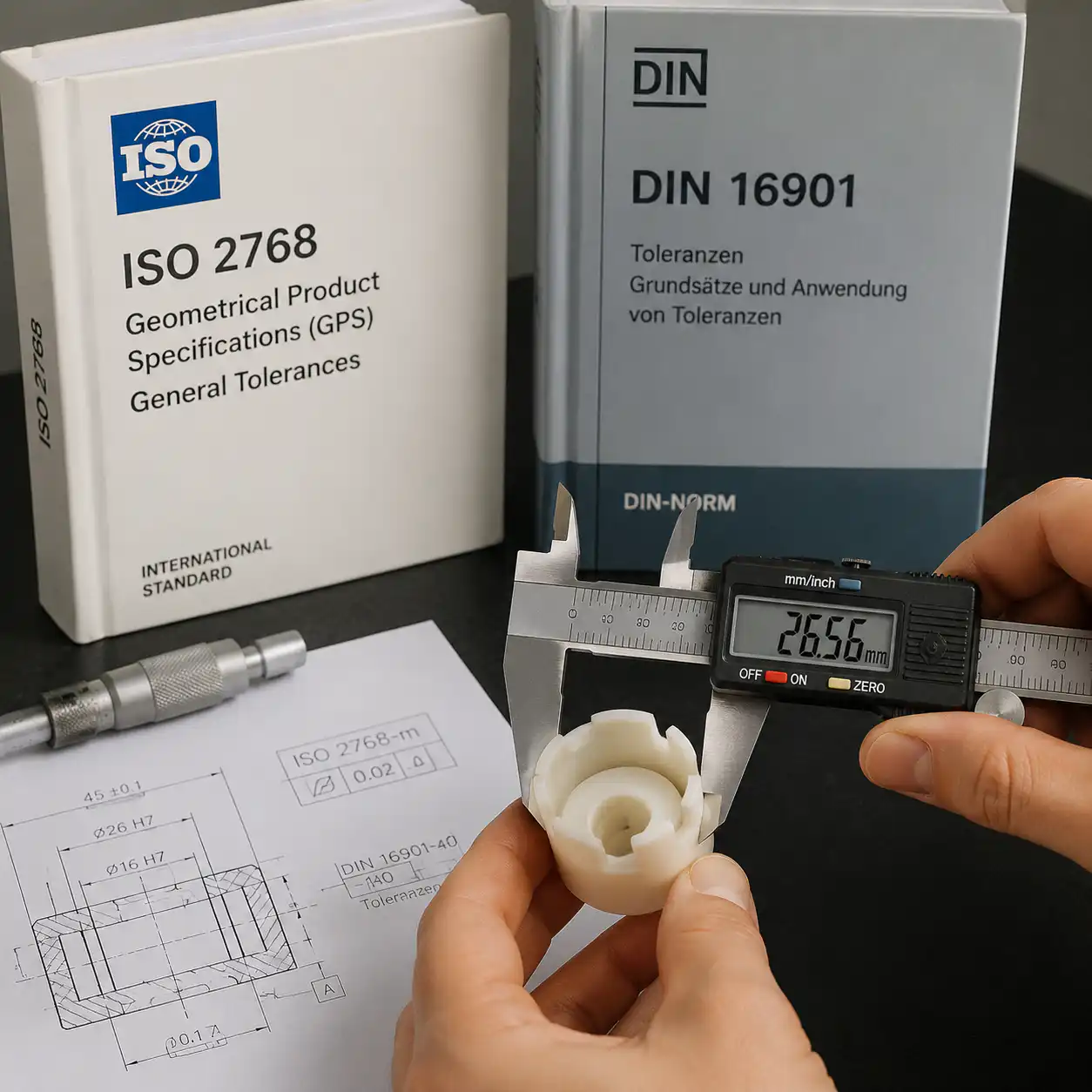
Dimensional tolerances are the silent make-or-break factor in every plastic injection molding project. A deviation of 0.05mm might be invisible to the eye, but it can mean the difference between a snap-fit that clicks perfectly and one that rattles loose. This comprehensive guide covers ISO 2768, DIN 16901, and the practical realities of achieving tight tolerances with engineering plastics.
Dimensional tolerances are the silent make-or-break factor in every plastic injection molding project. A deviation of 0.05mm might be invisible to the eye, but it can mean the difference between a snap-fit that clicks perfectly and one that rattles loose. This comprehensive guide covers ISO 2768, DIN 16901, and the practical realities of achieving tight tolerances with engineering plastics.
Why Tolerances Matter in Plastic Parts
Unlike metals, thermoplastics shrink during cooling — and they shrink anisotropically, meaning differently in flow and cross-flow directions. Add glass fiber orientation, mold temperature gradients, and varying wall thickness, and you have a complex dimensional puzzle. Getting tolerances right affects assembly fit, sealing performance, aesthetic quality, and ultimately your rejection rate and total cost.
ISO 2768 General Tolerances for Plastics
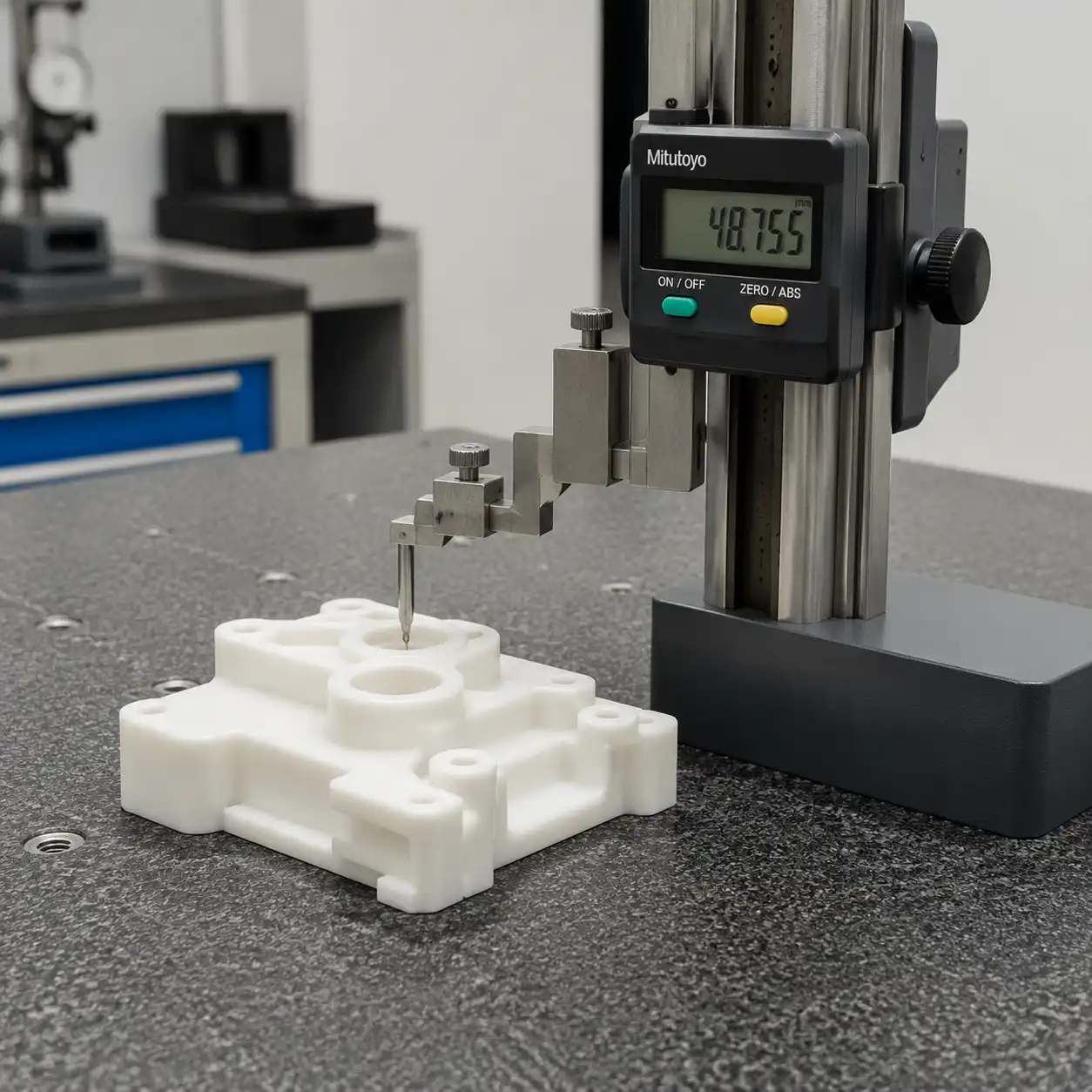
ISO 2768 provides general tolerance classes for linear dimensions and angular dimensions where no specific tolerance is indicated on the drawing. For plastic parts, the relevant standard is ISO 2768-1 (linear and angular dimensions) with the mK tolerance class typically applied.
| Tolerance Class | 0.5–3mm | 3–6mm | 6–30mm | 30–120mm | 120–400mm | 일반적인 애플리케이션 |
|---|---|---|---|---|---|---|
| f (fine) | ±0.05 | ±0.05 | ±0.1 | ±0.15 | ±0.2 | Precision gears, optical |
| m (medium) | ±0.1 | ±0.1 | ±0.2 | ±0.3 | ±0.5 | Most injection molded parts |
| c (coarse) | ±0.2 | ±0.3 | ±0.5 | ±0.8 | ±1.2 | Low-precision housings |
| v (very coarse) | ±0.5 | ±1.0 | ±1.5 | ±2.0 | ±3.0 | Large non-critical parts |
For most engineering plastic parts, ISO 2768-m is a reasonable starting point. ISO 2768-f is achievable only with careful mold design, stable processing, and materials with predictable shrinkage.
DIN 16901 — Injection Molding Specific Tolerances
DIN 16901 is the gold standard for injection molding tolerances. Unlike ISO 2768, it accounts for material-specific shrinkage behavior by grouping thermoplastics into shrinkage categories. This makes it far more practical for mold makers and quality engineers.
| 재료 | Shrinkage Group | Typical Shrinkage | Grade A (tight) | Grade B (standard) | Grade C (loose) |
|---|---|---|---|---|---|
| PA6/PA66 unfilled | Group 2 | 1.0–2.0% | ±0.1% | ±0.2% | ±0.4% |
| PA66 GF30 | Group 1 | 0.3–0.7% | ±0.05% | ±0.1% | ±0.2% |
| POM(아세탈) | Group 2 | 1.8–2.5% | ±0.1% | ±0.2% | ±0.4% |
| PC(폴리카보네이트) | Group 1 | 0.5–0.7% | ±0.05% | ±0.1% | ±0.2% |
| ABS | Group 1 | 0.4–0.7% | ±0.05% | ±0.1% | ±0.2% |
| PP unfilled | Group 3 | 1.5–2.5% | ±0.2% | ±0.4% | ±0.6% |
핵심 요점: Glass fiber reinforcement dramatically improves dimensional stability. PA66 GF30 (Group 1) can achieve tolerances nearly as tight as unfilled PC, while unfilled PA66 (Group 2) needs wider tolerance allowances due to higher and more variable shrinkage.
How Shrinkage Affects Achievable Tolerance
Shrinkage is the single largest variable in plastic part tolerances. Here is how different materials compare:
- Nylon 6/66 unfilled: 1.0–2.0% shrinkage. A 100mm dimension can vary by 1–2mm just from the material alone, before considering mold and process variation.
- Nylon 66 GF30: 0.3–0.7% in flow direction, 0.7–1.0% cross-flow. The glass fiber constrains shrinkage but creates anisotropy — dimensions differ depending on fiber orientation.
- POM: 1.8–2.5% — the highest shrinkage of common engineering plastics, which is why tight-tolerance POM parts need very precise mold compensation.
- PC: 0.5–0.7% — excellent dimensional stability, making it a preferred choice for optical and precision applications.
The mold maker must calculate cavity dimensions as: Nominal Dimension × (1 + Shrinkage Rate), then fine-tune after first-shot samples. Modern Moldflow simulation predicts shrinkage within ±0.1% accuracy when properly calibrated.
Tolerance Stack-Up Analysis
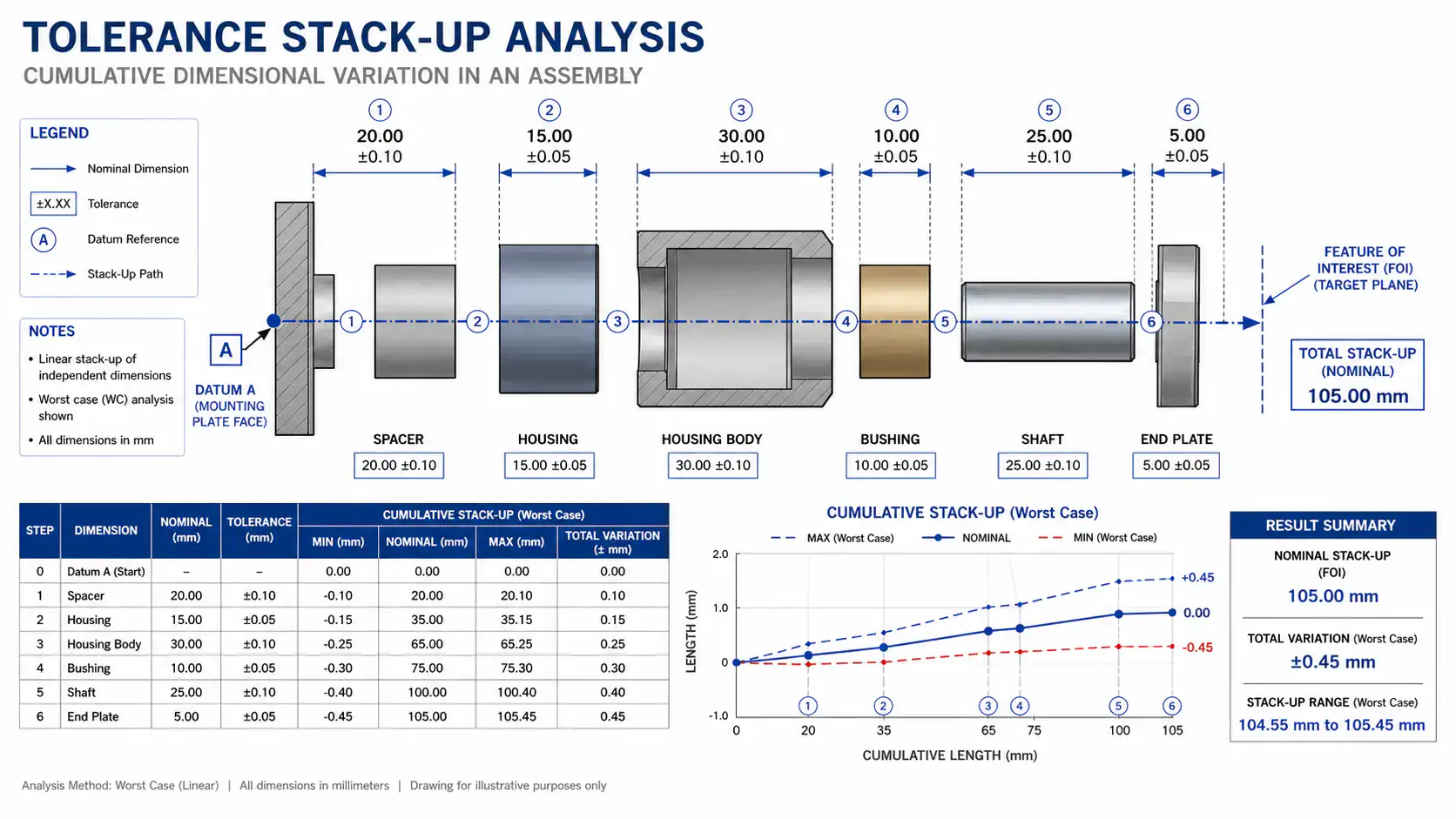
When multiple toleranced features interact in an assembly, their individual tolerances accumulate. The practical formula for worst-case stack-up is:
Ttotal = T1 + T2 + … + Tn
For statistical (RSS) stack-up, which is more realistic for production volumes:
Ttotal = √(T1² + T2² + … + Tn²)
Common mistakes include forgetting to account for the mold split line tolerance, ignoring thermal expansion differences between assembled materials, and treating shrink rates as constants rather than ranges. Always run a tolerance analysis before finalizing mold steel — it is far cheaper than discovering interference at first-shot inspection.
Design for Tolerance — Best Practices
Uniform wall thickness: The single most effective way to improve dimensional control. Thick-to-thin transitions cause differential cooling and warpage.
Gate location: Position the gate so the melt front fills the cavity uniformly, minimizing anisotropic shrinkage. A poorly placed gate creates asymmetric flow patterns that warp the part.
Mold steel selection: For tight tolerances (±0.02mm or better), use hardened tool steel (H13, S136) rather than P20. Hardened steel holds dimensions longer and provides better surface finish, reducing the need for post-molding compensation.
Draft angles and ejection: Ejector pin placement affects flatness. Uneven ejection force distorts the part while it is still warm, creating permanent dimensional errors.
Measurement Methods for Plastic Parts
| 방법 | 정확도 | 최상의 대상 | Cost Level |
|---|---|---|---|
| Caliper | ±0.02mm | Quick checks, simple features | $ |
| Micrometer | ±0.001mm | Wall thickness, precision diameters | $ |
| Gauge pins | ±0.005mm | Hole diameters, go/no-go | $$ |
| Optical comparator | ±0.005mm | Profiles, radii, 2D geometry | $$$ |
| CMM (Coordinate Measuring Machine) | ±0.001mm | Full 3D dimensional inspection | $$$$ |
| 3D scanning | ±0.02–0.05mm | Complex freeform surfaces, comparison to CAD | $$$ |
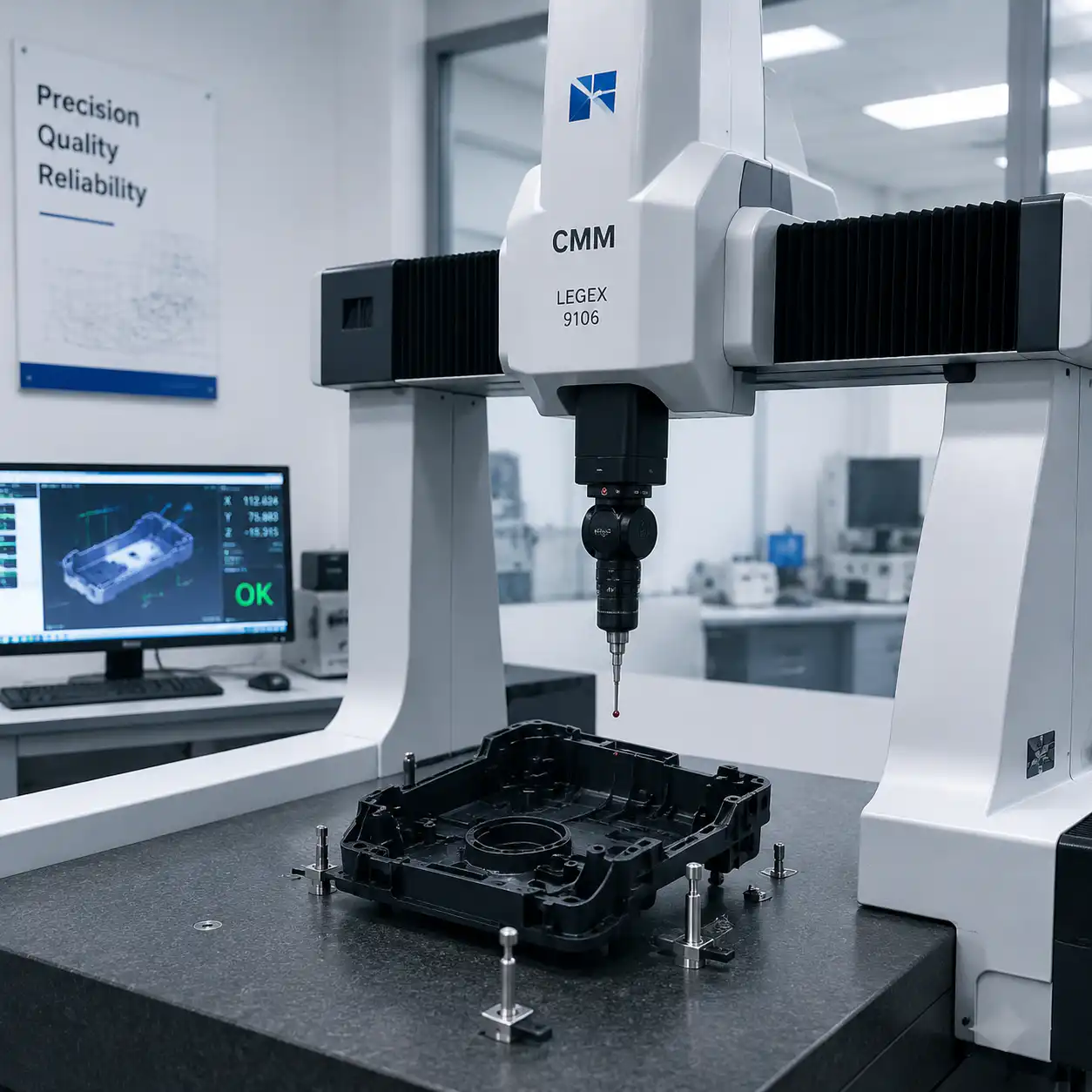
For production QC, a combination of gauge pins (fast go/no-go for critical bores) and periodic CMM inspection (full dimensional report for PPAP/ISIR) is the industry standard.
The Cost of Tighter Tolerances
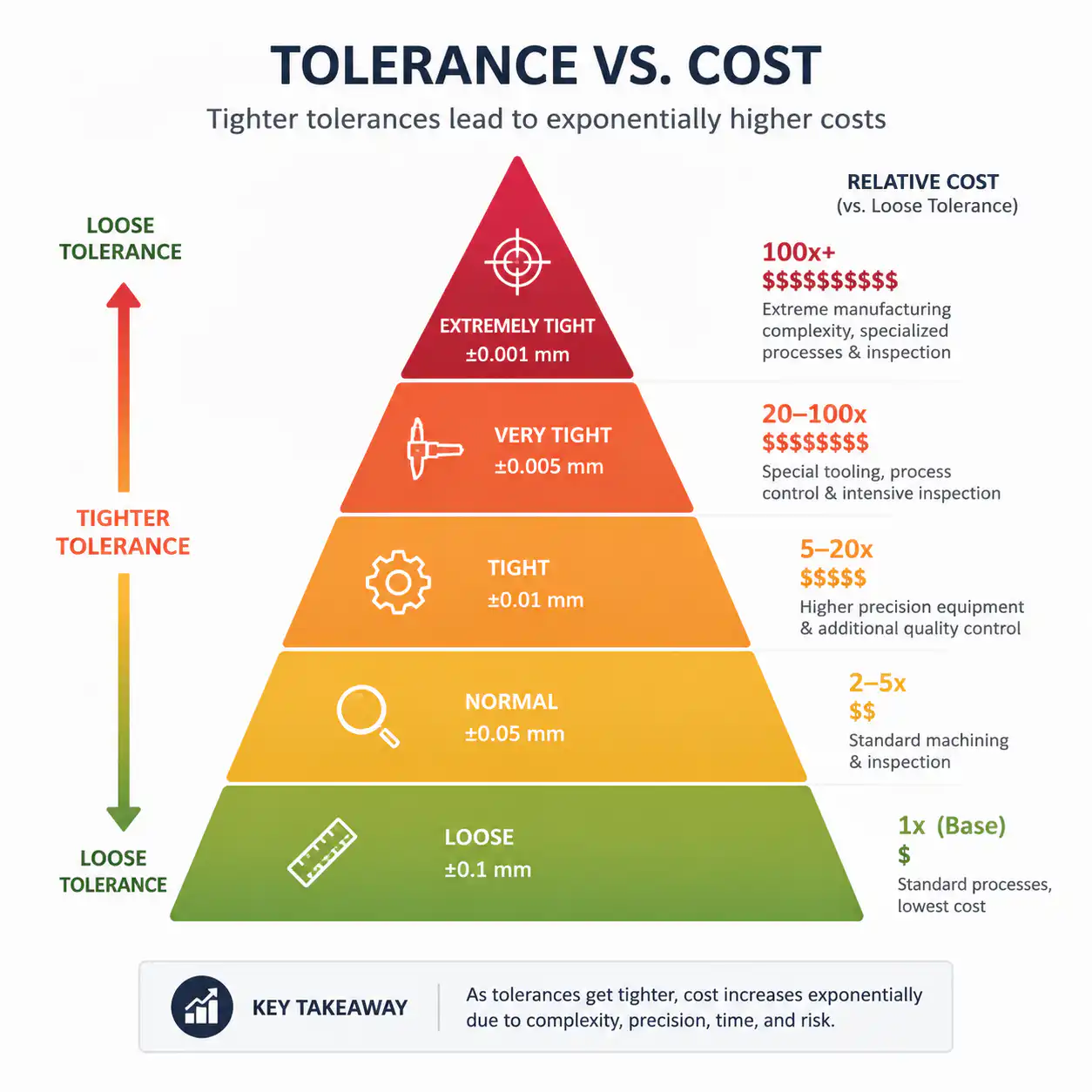
Every decimal place in your tolerance specification increases cost. Here is a practical cost pyramid for injection molded nylon parts:
| Tolerance Band | Mold Cost Premium | Part Cost Premium | Rejection Rate |
|---|---|---|---|
| ±0.5mm | 기준선 | 기준선 | 0.5–1% |
| ±0.2mm | +5–10% | +3–5% | 1–3% |
| ±0.1mm | +15–25% | +10–15% | 3–5% |
| ±0.05mm | +30–50% | +20–30% | 5–10% |
| ±0.02mm | +60–100% | +40–60% | 10–20% |
The premium is not just financial: tighter tolerances also increase mold lead time (additional EDM and polishing) and require more frequent QC inspection during production.
결론 및 권고 사항
Specifying tolerances for injection molded plastic parts requires balancing functional requirements with manufacturing reality. For nylon parts, the sweet spot is typically DIN 16901 Grade B (standard) — it provides adequate precision for most mechanical applications without excessive cost premiums. Glass-filled grades can reliably achieve Grade A tolerances thanks to their lower and more predictable shrinkage. Always involve your mold maker early in the tolerance specification process: their experience with your specific material and geometry is worth more than any general standard.
자주 묻는 질문
사출 성형된 나일론의 경우, 달성 가능한 가장 엄격한 공차는 얼마입니까?
For unfilled nylon (PA6/PA66), practical tight tolerance is ±0.05mm for dimensions under 10mm, and approximately ±0.1% of the nominal dimension for larger features. With PA66 GF30, you can reliably achieve ±0.03mm for small features due to the glass fiber’s shrinkage-constraining effect. Achieving tighter than ±0.02mm requires post-molding CNC machining.
플라스틱 부품 도면에 공차를 어떻게 명시해야 하나요?
일반 공차 표준으로는 ISO 2768-mK를 참조하고, 중요 치수에 대해서는 개별적으로 더 엄격한 공차를 명시하십시오. 특히 사출 성형 부품의 경우, DIN 16901을 참조하여 공차 등급(A/B/C)과 재료 수축 그룹을 함께 명시하십시오. 나일론은 수분 흡수에 따라 치수가 변하므로, 공차 적용 시점이 성형 시점인지 아니면 24시간 컨디셔닝 후인지 항상 명시해야 합니다.
유리 섬유는 치수 공차를 개선하나요, 아니면 악화시키나요?
유리 섬유는 수축을 줄이고 안정화시켜 치수 공차를 크게 개선합니다. PA66 GF30의 수축률은 0.3–0.7%인 반면, 충전제가 첨가되지 않은 PA66의 수축률은 1.0–2.0%입니다. 그러나 유리 섬유는 이방성 수축(유동 방향과 횡유동 방향에 따라 수축률이 다름)을 유발하므로, 금형 설계자는 게이트 위치 설정 및 캐비티 치수 조정을 통해 이를 보정해야 합니다. 결과적으로 치수 제어에 매우 긍정적인 영향을 미칩니다.
What does ‘free tolerance’ mean in plastic manufacturing?
자유 공차란 도면에서 해당 치수에 대해 개별적인 공차가 지정되지 않았음을 의미하며, 따라서 참조 표준(일반적으로 플라스틱 부품의 경우 ISO 2768-m)에 명시된 일반 공차가 기본값으로 적용됩니다. ISO 2768-m에 따른 50mm 치수의 경우, 자유 공차는 ±0.3mm가 됩니다. 자유 공차는 도면의 복잡성을 줄이고 제조 비용을 절감하지만, 기능적 또는 결합 관련 치수가 아닌 경우에만 사용해야 합니다.